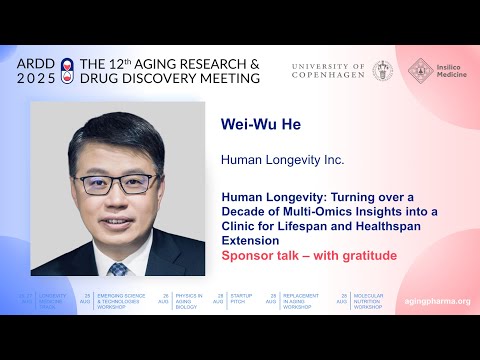
Wei-Wu He, Executive Chairman and CEO of Human Longevity Inc., presents at the 25th Aging Research and Drug Discovery meeting: Human Longevity: Turning over a Decade of Multi-Omics Insights into a Clinic for Lifespan and Healthspan Extension
Wei-Wu He at ARDD2025: Human Longevity: Turning over a Decade of Multi-Omics Insights
Gemini Pro AI Summary and Analysis of Video
Based on the transcript provided, here is the rigorous summary and adversarial peer review.
A. Executive Summary
The speaker, representing Human Longevity Inc. (HLI), argues that the next major leap in human life expectancy—potentially pushing the average to 100—will not come from a single drug, but from comprehensive, multi-modal early detection. Using the historical analogy of Ignaz Semmelweis (who discovered handwashing reduced maternal mortality long before the germ theory was understood), the speaker positions Whole Genome Sequencing (WGS) combined with full-body imaging (MRI) and liquid biopsy as the modern “handwashing” solution.
The core thesis relies on data from HLI’s clinic (Health Nucleus), specifically a study of ~1,200 “healthy” individuals where 14% were found to have immediate, life-altering pathology (e.g., tumors, aneurysms) and 40% had significant long-term genetic risks. The speaker critiques the current “sick care” model (treating Stage 4 cancer) and advocates for an “Algorithm as a Service” model to detect the “Top 6 Killers” (CVD, Cancer, Dementia, etc.) at Stage 0 or 1. The presentation concludes with a commercial pitch for their premium clinics and a specific guarantee regarding their prostate cancer detection algorithm.
B. Bullet Summary
-
The Semmelweis Analogy: Just as handwashing was a low-tech intervention that saved lives before the mechanism was understood, the speaker argues that data-driven screening is today’s underutilized “handwashing” for longevity.
-
Technological Deflation: The cost of sequencing a human genome has dropped from ~$100 million (25 years ago) to <$1,000, yet it remains unutilized by the general population.
-
The “Healthy” Patient Myth: In HLI’s cohort of ~1,200 self-described healthy adults, 14% had clinically significant findings requiring immediate attention (e.g., early-stage tumors, aortic aneurysms).
-
Polygenic Risk Scores (PRS): We only understand ~5% of the genome regarding disease, necessitating longitudinal AI analysis to unlock the rest.
-
Prostate Cancer Algorithm: HLI claims to have developed a detection algorithm (Genomics + PSA + MRI) with an Area Under the Curve (AUC) >0.9, significantly outperforming standard PSA testing.
-
Liquid Biopsy Evolution: Mentions “Avant” (likely referencing 5-hydroxymethylation technology developed by Stephen Quake) for early pancreatic cancer detection via blood markers.
-
The “Million Dollar Pledge”: The speaker offers a warranty: if a member develops late-stage prostate cancer while under their protocol, HLI will pay $1M for treatment, signaling high confidence in their negative predictive value.
-
Economic Longevity: Acknowledges that living to 100 is undesirable without financial planning (“Longevity Financial Planning”), adding wealth as a 5th pillar of health.
-
Top Causes of Death: To extend life significantly, one must delay the onset of: Cardiovascular Disease, Cancer, Accidental Death, Dementia, and Metabolic Disease.
-
Democratization Goal: While currently a luxury service, the goal is to scale the “Algorithm as a Service” (AaaS) to democratize precision medicine globally, specifically targeting India and China.
C. Claims & Evidence Table (Adversarial Peer Review)
Role: Longevity Scientist. Objective: Validate strict medical claims against consensus data.
| Claim from Video |
Speaker’s Evidence |
Scientific Reality (Best Available Data) |
Evidence Grade |
Verdict |
| “14% of healthy people have life-threatening findings upon deep screening.” |
Cites HLI’s own study (Perkins et al., PNAS 2018). |
The Perkins study (n=1,190) did find ~2% genomic & significantly higher imaging findings. However, critics argue this leads to “incidentalomas” and over-diagnosis/over-treatment of benign issues. |
C (Observational/ Cohort) |
True but Contextual (Risk of Over-diagnosis) |
| “Handwashing reduced maternal mortality from 30% to <5%.” |
Historical anecdote of Semmelweis. |
Historical records confirm Vienna General Hospital mortality dropped from ~18% to ~2% after chlorine wash. Speaker’s directional accuracy is correct, though percentages vary by specific year. |
C (Historical Record) |
Supported |
| “Genetics determine potential; Humans endowed to live to 100.” |
Cites rare “super-agers” and lack of “death genes.” |
Heritability of human lifespan is only ~15–25% (Ruby et al., Genetics 2018). Environment/Lifestyle dominates. There is no evidence that all humans have the genetic plasticity for 100 years. |
E (Expert Opinion) |
Speculative / Hyperbolic |
| “Prostate Cancer Algorithm has AUC > 0.9 (90%+ accuracy).” |
Internal HLI data/cohort. |
Standard PSA AUC is poor (~0.6-0.7). Combining MRI + PSA + Genetics improves this (STHLM3 study, Lancet Oncol 2015). Achieving >0.9 is exceptional and requires external validation in a randomized trial to be accepted as standard. |
C (Internal Data) |
Plausible but Unverified |
| “Pancreatic Cancer detected early via 5-hydroxymethylation (Liquid Biopsy).” |
References Stephen Quake/Stanford tech. |
Emerging data (e.g., Nature Communications 2020, Gamelin et al.) shows 5hmC is promising for early detection, but sensitivity for Stage I remains the industry bottleneck. Not yet clinical standard of care. |
C/D (Emerging Tech) |
Experimental |
| “Genome sequencing is <$1,000 today.” |
Industry observation. |
Verified. Illumina and others offer WGS services at this price point (clinical grade often higher, consumer grade lower). |
A (Market Fact) |
Fact |
D. Actionable Insights (Pragmatic & Prioritized)
The speaker advocates for “High-Performance Health” requiring significant capital. Below is the synthesized protocol, graded by accessibility.
Tier 1: The “Semmelweis” Basics (High Impact, Low Cost)
-
Aggressive Lipid Management: The speaker identifies CVD as the #1 killer. Standard of care (statins/PCSK9 inhibitors) based on ApoB levels is the modern equivalent of “washing hands” for arteries.
-
Colonoscopy/Cancer Screening: Adhere strictly to guidelines. The speaker notes that removing a polyp at Stage 0 prevents Stage 4 cancer entirely.
-
Accident Prevention: Physical stability training (muscle/bone density) to prevent falls (the #3 killer mentioned).
Tier 2: Advanced Diagnostics (The HLI Protocol)
-
Whole Genome Sequencing (WGS):
-
Action: Screen for hereditary cancer syndromes (Lynch, BRCA) and cardiovascular risks (Familial Hypercholesterolemia).
-
Caveat: Only ~2-5% of people will find a “smoking gun.” For the rest, it is risk stratification (PRS).
-
Full Body MRI (DWI/Stir sequences):
-
Action: Detect early solid tumors or aneurysms.
-
Warning: High risk of false positives (“incidentalomas”) which can lead to unnecessary anxiety and invasive biopsies.
Tier 3: Experimental/Emerging
-
Liquid Biopsy: Use tests like Grail (Galleri) or specific 5hmC assays for multi-cancer early detection (MCED). Note: A negative result does not guarantee no cancer.
E. Technical Deep-Dive: The “Incidentaloma” Problem
The speaker’s central argument relies on the and full-body imaging to find “hidden” disease. However, a major debate in longevity medicine is the “Incidentaloma.”
-
The Mechanism: When you scan a “healthy” human with high-resolution MRI, you frequently find cysts, nodules, and abnormalities that are benign and indolent (slow-growing).
-
The Risk: A 14% “significant finding” rate sounds heroic, but if 5% of those lead to biopsies that cause infection, bleeding, or psychological trauma for a benign nodule, the Net Clinical Benefit decreases.
-
The HLI Approach: They argue that AI and multi-modal data (combining the image with the genetics) reduce these false positives. For example, a nodule in a patient with a p53 mutation is treated differently than a nodule in a patient with low genetic risk. This integration is the core technical value proposition of their “Algorithm as a Service.”
F. Statistics on Longevity & Demographics
The speaker implies broad democratization, but current longevity statistics highlight significant disparities.
-
Life Expectancy Gap: In the US, there is a ~15-year life expectancy gap between the wealthiest 1% and the poorest 1% (Chetty et al., JAMA 2016).
-
Racial Disparities in Prostate Cancer: The speaker focuses heavily on Prostate Cancer. Statistics show that Black men in the US are 1.7 times more likely to be diagnosed with prostate cancer and 2.1 times more likely to die from it compared to White men (American Cancer Society, 2024).
-
Context: HLI’s algorithm needs to be validated across diverse racial cohorts to be truly effective, as Polygenic Risk Scores (PRS) have historically been biased toward European ancestries.
G. Fact-Check: Important Claims
-
Claim: “Antibiotics and vaccines are the biggest contributors to the life expectancy jump.”
-
Check: True. The reduction in infant mortality via infectious disease control drove the shift from ~45 to ~75 years. The shift from 80 to 100+ requires solving aging itself (chronic disease).
-
Claim: “80% of us have the potential to live over 100.”
-
Check: Controversial. While we may lack “death genes,” reaching 100 (Centenarian status) is currently achieved by only ~0.03% of the US population. Claiming 80% have the potential assumes a perfectly optimized environment that currently does not exist.