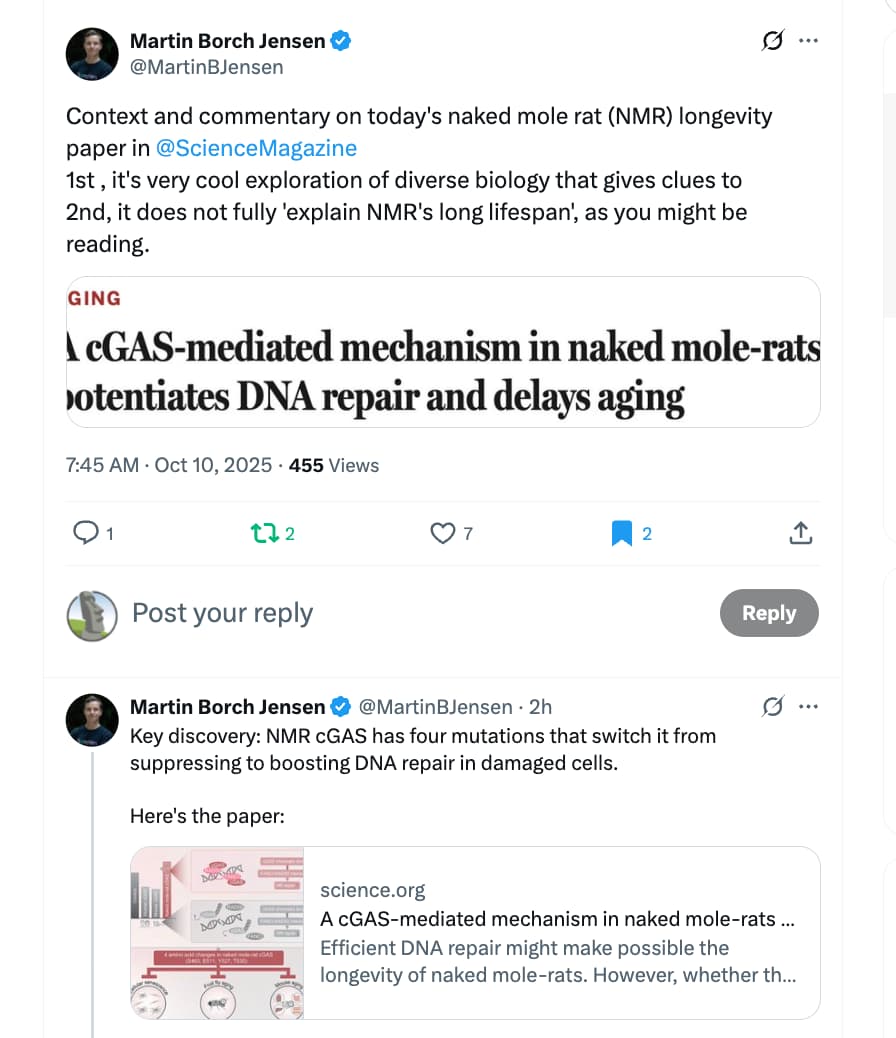
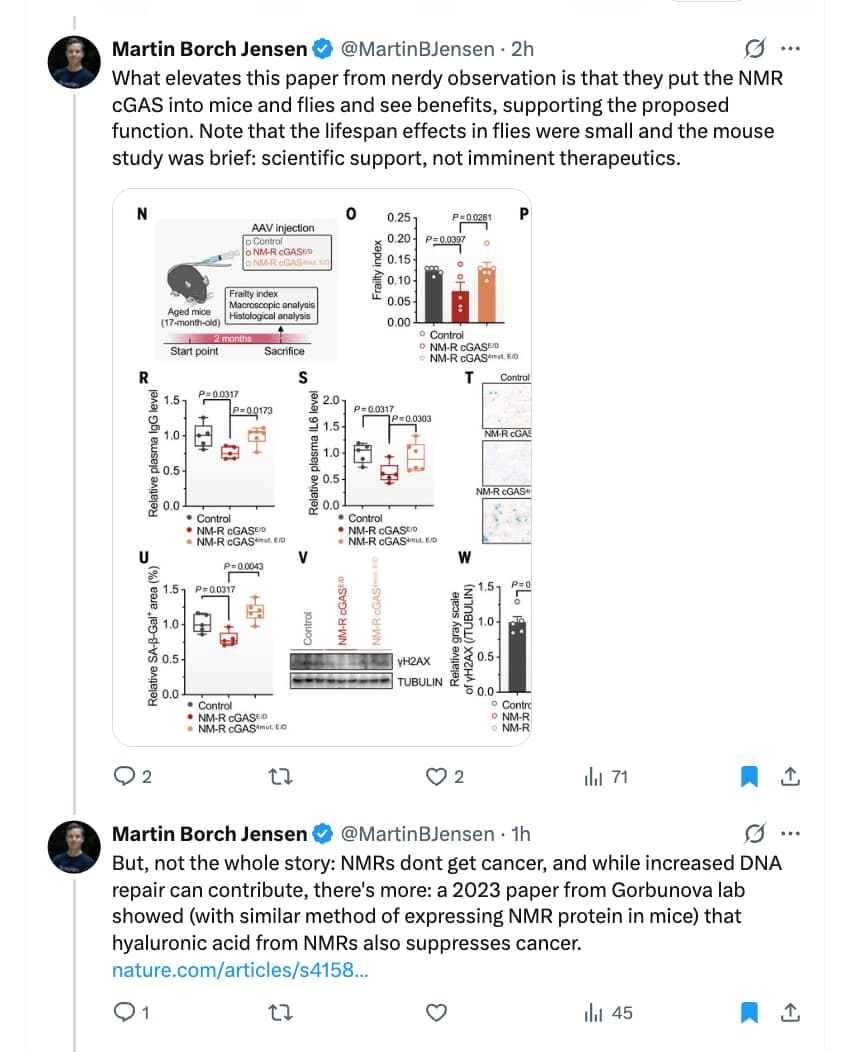
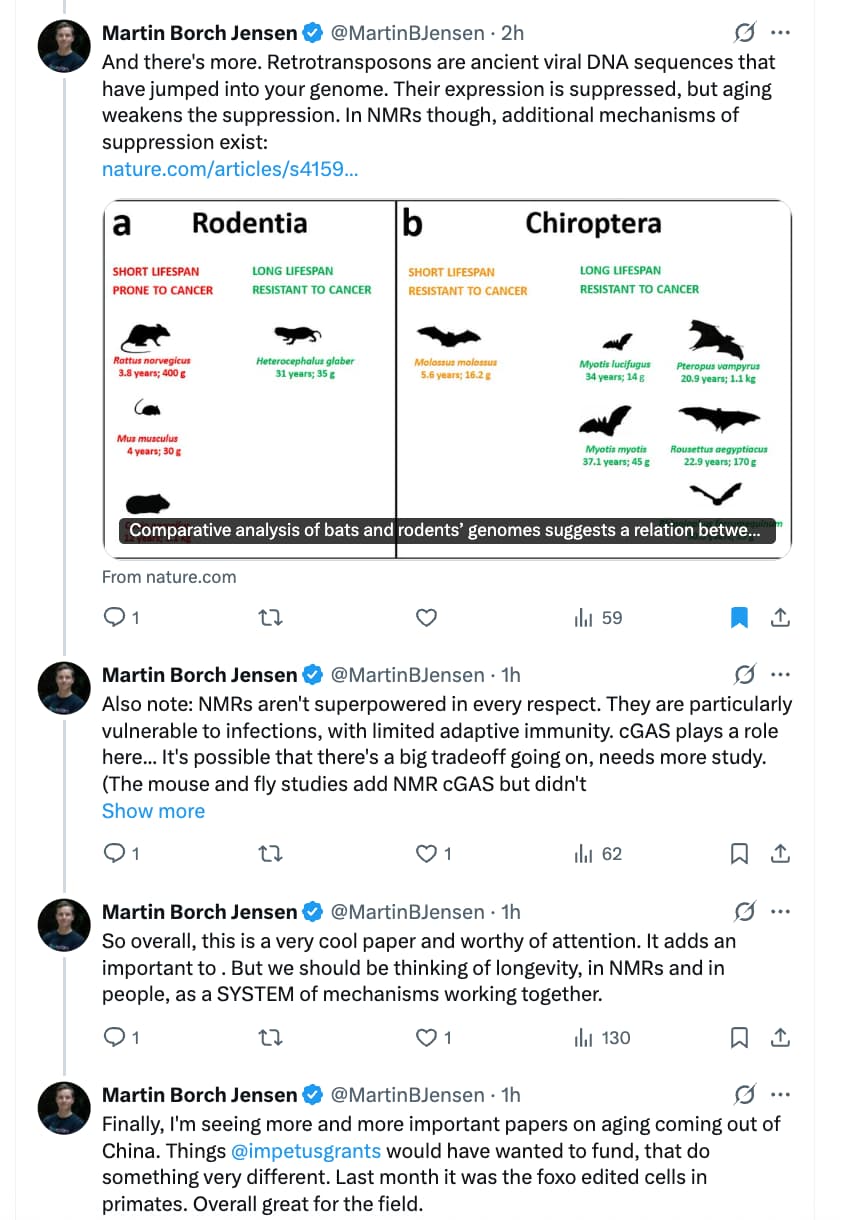
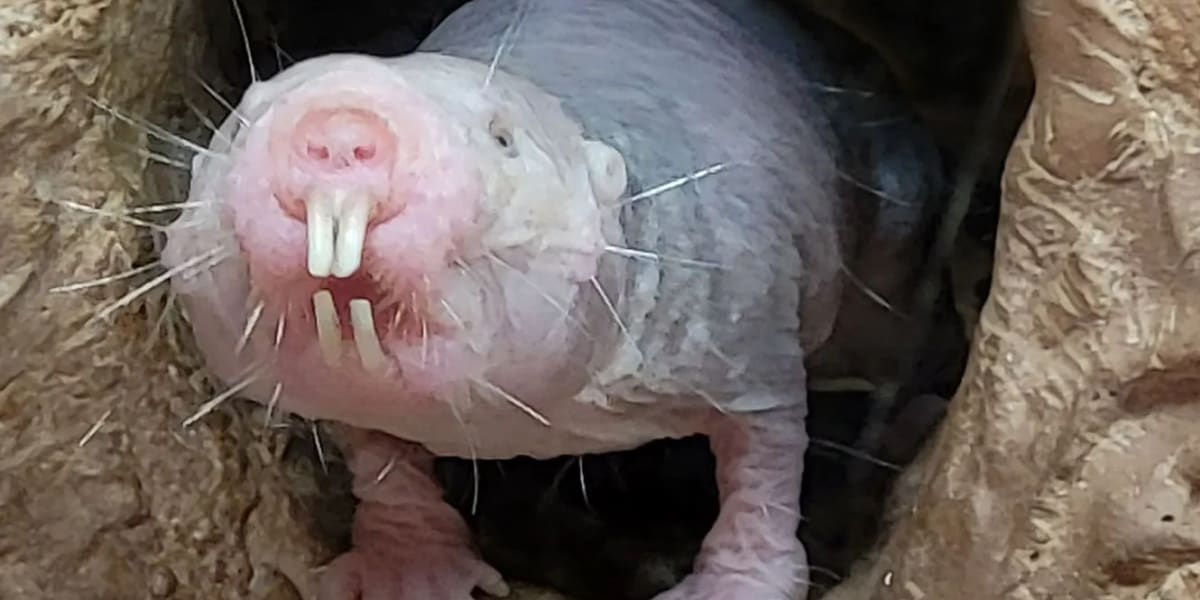
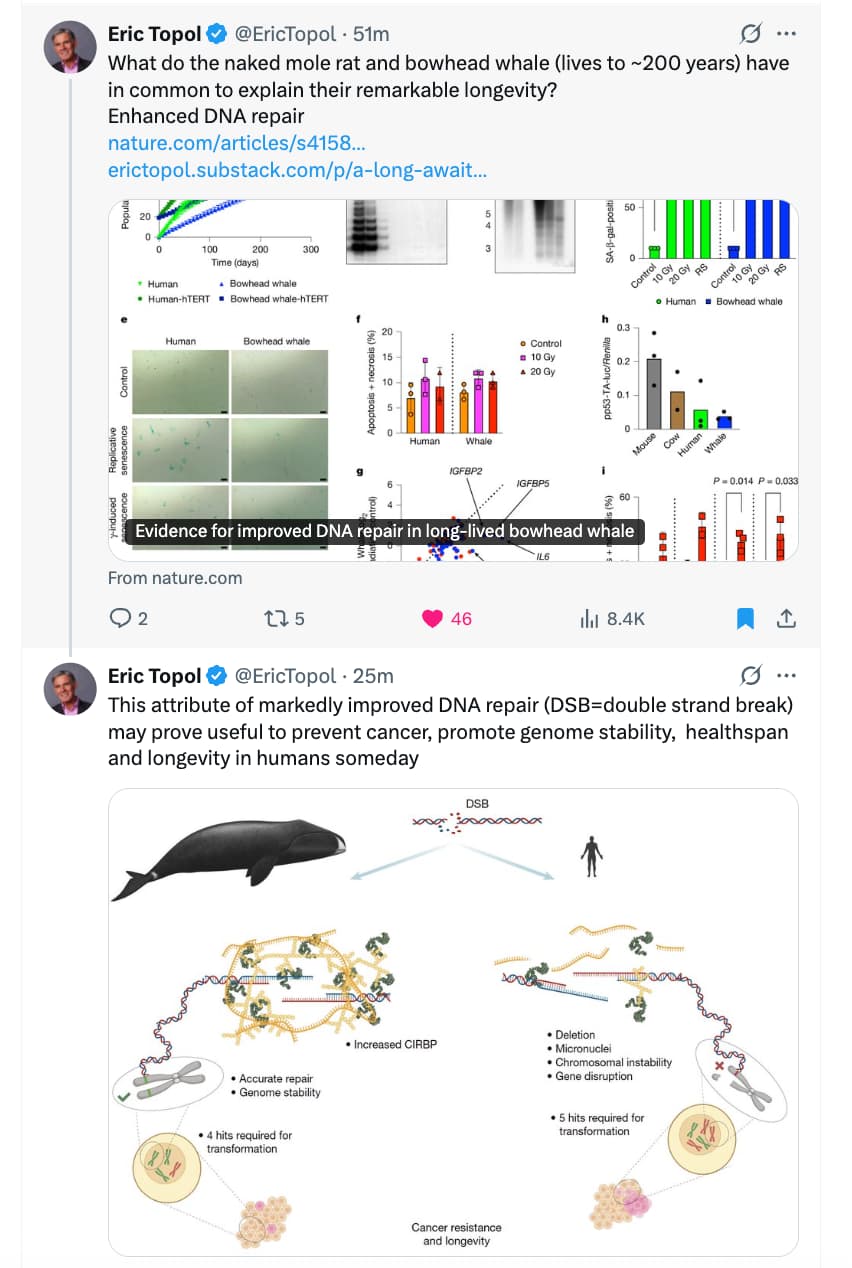
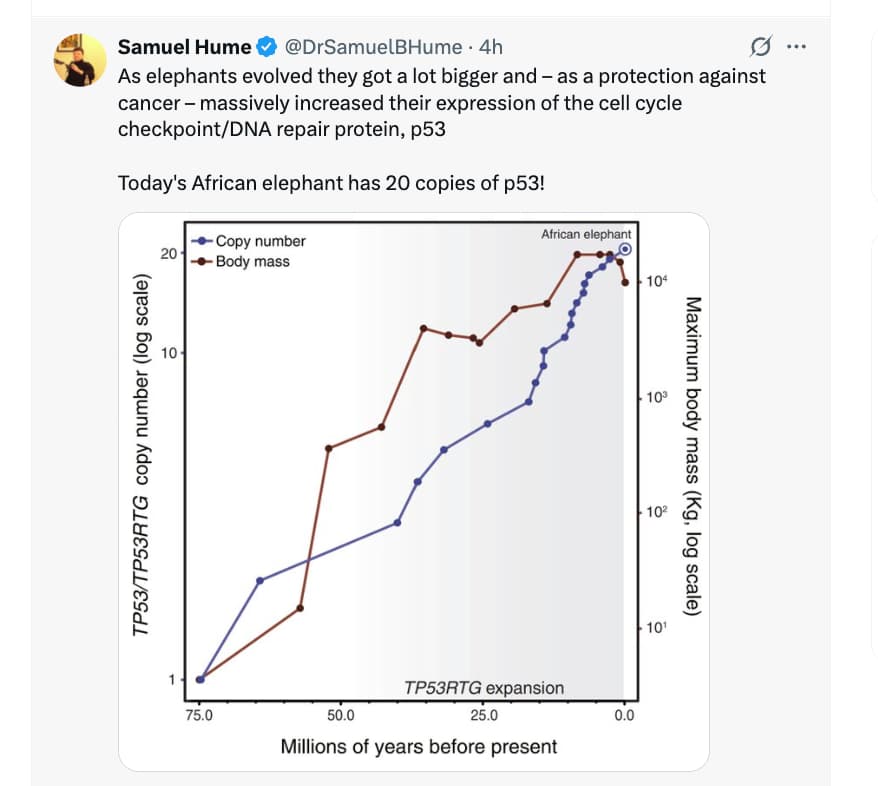
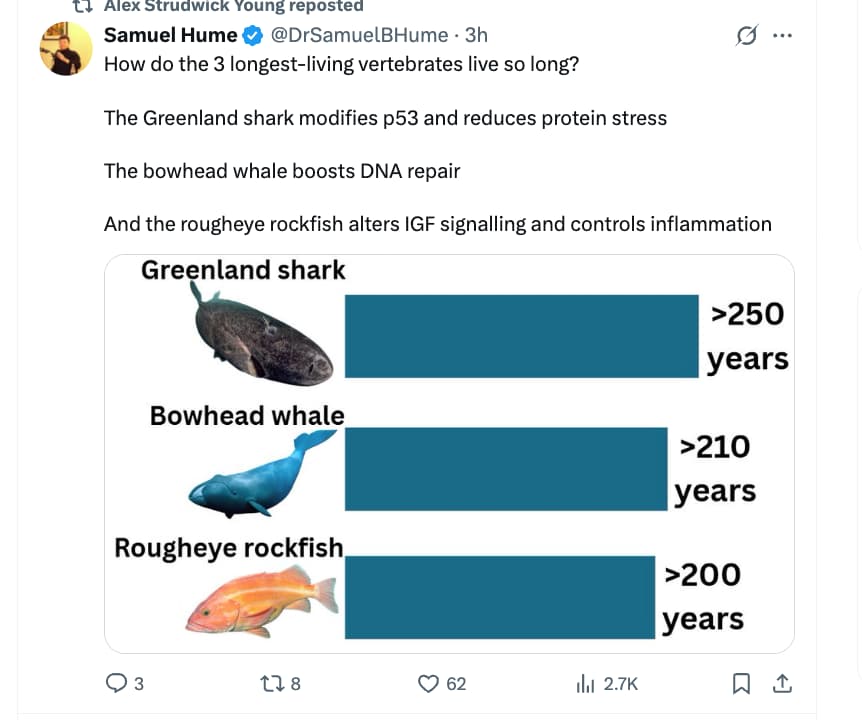
A simplistic look at this research would suggest that if we just inserted extra copies of the P53 gene in humans, cancer would be a non-issue. Alas, not so simple:
ChatGPT5.1 Summary:
Short version:
Yes—people have made “extra-p53” mammals. In mice, extra Trp53 copies clearly lower cancer incidence, but by themselves they do not robustly extend lifespan. The only clear extension of lifespan comes from models with extra, but tightly regulated, Arf + p53 together, and even there the effect is modest. When p53 is made too active or deregulated, you get cancer resistance plus premature aging and shorter life.
1. Core mouse models with extra p53 copies
1.1 “Super p53” mice – extra Trp53 under its own promoter
Construct / design
- Bacterial artificial chromosome (BAC) transgene carrying an intact Trp53 locus (promoter + regulatory elements), added on top of the two endogenous alleles → many animals effectively have 3 functional copies of p53 (“super p53”). (PMC)
Cancer outcomes
-
Cells from super-p53 mice show:
- Higher basal p53 levels and stronger induction after DNA damage.
- More robust induction of p21 and increased apoptosis after irradiation. (PMC)
-
In vivo, they have markedly reduced spontaneous tumor incidence and delayed tumor onset versus wild-type littermates. (PMC)
-
Used later as a gain-of-function model to show that an extra p53 copy suppresses Kras-mutant lung adenomas and lymphomas, although it does not protect well against radiation-induced lymphomas. (JCI Insight)
Longevity / aging
- Original EMBO J paper: super-p53 mice age normally, with no obvious progeroid features. (PMC)
- No convincing increase in lifespan: survival curves are essentially superimposable on wild-type; ~70% of mice in both groups are alive at 2 years in one report. (Science)
- Follow-up work where super-p53 was combined with telomere dysfunction shows that increased p53 activity does not exacerbate telomere-driven degenerative aging, arguing that physiologically regulated extra p53 can be “safe” for aging. (EMBO Press)
Bottom line:
Extra, normally regulated p53 → stronger DNA-damage response and fewer cancers, but no lifespan extension and no premature aging.
1.2 Constitutively high p53 activity via Mdm2 attenuation
Construct / design
- Mendrysa et al. engineered mice with reduced expression of Mdm2, the main negative regulator of p53. This leads to chronically elevated p53 activity, somewhat analogous in outcome to “more p53,” even though the gene copy number itself isn’t increased. (PubMed )
Cancer outcomes
- These mice are highly cancer-resistant across several tumor models. (PubMed )
Longevity / aging
- Despite “constitutively high” p53 activity, they do not show accelerated aging and have essentially normal lifespan, contrasting with earlier hyperactive p53 mutants (see below). (PubMed )
Interpretation:
It supports the idea that moderate, well-controlled elevation of p53 activity can give cancer protection without obvious aging penalty—similar conclusion to super-p53—but again, no clear life-extension.
1.3 Extra Arf + p53 dosage – where you do see lifespan extension
These models are closest to what you asked about in terms of both cancer and longevity.
1.3.1 “Super Ink4a/Arf” alone
- Extra copy of the Ink4a/Arf locus, giving modestly higher p16^Ink4a and p19^Arf activity, under normal regulation. (arep.med.harvard.edu)
- Phenotype: increased cancer resistance, but normal aging and lifespan; no significant life extension. (Genes & Development)
1.3.2 “s-Arf/p53” (super Arf + super p53, both regulated)
- Matheu et al. then crossed “super p53” with “super Ink4a/Arf” to generate mice with extra, but normally regulated, copies of both p53 and Arf (often called s-Arf/p53). (Nature)
Cancer outcomes
Longevity / aging
-
This is the key positive result:
- s-Arf/p53 mice show delayed appearance of aging phenotypes (better neuromuscular performance, preserved dermal thickness, reduced lipofuscin/oxidative damage markers, etc.). (Nature)
-
Median lifespan is significantly increased (roughly on the order of ~15–20% in the main cohorts), and this persists even if you censor out all mice that died of cancer. Maximum lifespan is not clearly extended. (Nature)
-
Later work by Carrasco-García et al. dissected this further, showing that increased Arf/p53 dosage preserves stem-cell function, delays stem-cell exhaustion, and extends lifespan, again without obvious trade-off in degenerative pathology. (PMC)
Bottom line:
This is the one clear engineered mouse model where extra p53 copy number (together with extra Arf) → strong tumor suppression plus modestly extended lifespan and delayed aging, provided regulation is left intact.
2. Hyperactive or truncated p53: cancer-resistant but short-lived
These models don’t add extra gene copies, but they are crucial for interpreting the “more p53” question.
2.1 Truncated / hypermorphic p53 (p53+/m; p44 etc.)
These models are often cited as evidence that p53 activation is pro-aging, but the later “super p53” and “s-Arf/p53” work shows that this is a regulation problem, not an in-principle trade-off: when p53 is chronically and inappropriately active, you age faster; when it is only more responsive to damage but otherwise normally controlled, you can get cancer resistance without an obvious lifespan cost, and sometimes with a modest benefit.
3. Non-mouse mammals with extra TP53 copies
Here we mostly have comparative / natural experiments, not engineered animals.
3.1 Elephants: 20 copies of TP53
This is consistent with the mouse “super-p53” story: increased p53 gene copy number, tightly regulated, seems compatible with long lifespan and low cancer risk. But in elephants this is an evolutionary outcome, not an engineered intervention, and you can’t cleanly decouple p53 from many other co-evolved traits.
To date there are no published reports of deliberately adding extra TP53 copies to other large mammals (dogs, primates, etc.) with lifespan readouts; work is mainly in mice plus comparative genomics in elephants, whales, naked mole-rats, etc. (PMC)
4. Condensed comparison table
| Model |
Genetic change |
p53 regulation |
Cancer effect |
Longevity / aging effect |
|
Super p53 mouse (García-Cao 2002) |
Extra wild-type Trp53 locus (BAC), 3 copies total |
Native promoter; p53 only rises under stress |
Strong reduction in spontaneous tumors; enhanced DNA-damage response |
Normal aging; no clear lifespan extension (PMC) |
|
High-p53 via low Mdm2 (Mendrysa 2006) |
Diminished Mdm2 expression → chronically higher p53 |
Still under endogenous Trp53 promoter; feedback relaxed |
Marked cancer resistance |
Normal lifespan; no overt progeria (PubMed ) |
|
Super Ink4a/Arf (Matheu 2004) |
Extra Ink4a/Arf locus |
Native regulation |
Increased cancer resistance |
Normal aging and lifespan (arep.med.harvard.edu) |
|
s-Arf/p53 (Matheu 2007) |
Extra Trp53 + extra Ink4a/Arf
|
Native regulation for both |
Very strong, broad cancer resistance |
Delayed aging, reduced molecular damage, modestly ↑ median lifespan, max lifespan unchanged (Nature) |
| Hyperactive p53 (p53+/m, p44, etc.) |
Mutant / truncated alleles → chronically hyperactive p53 |
Largely deregulated, stress-independent |
High cancer resistance |
Premature aging and shortened lifespan (ScienceDirect) |
| Elephant (natural) |
~20 TP53 copies (retrogenes + canonical) |
Co-evolved, highly regulated system |
Very low lifetime cancer mortality vs body size |
Long lifespan with low cancer; not an engineered test but strong circumstantial support (PMC) |
5. How to interpret this for “cancer risk vs longevity”
What is clearly shown
-
Yes, extra p53 copies in mammals can lower cancer risk.
- In mice, an extra wild-type Trp53 copy gives robust tumor resistance. (PMC)
- In elephants, many TP53 copies correlate with unusually low cancer mortality. (EvolutionMedicine)
-
Extra p53 alone does not reliably extend lifespan in mice.
- Super-p53 and high-p53 models age normally; they don’t clearly live longer. (Science)
-
Combined Arf + p53 extra dosage, under normal regulation, can modestly extend lifespan and delay aging.
- s-Arf/p53 mice: higher median lifespan, delayed functional and molecular aging markers, and effect persists when you remove cancer deaths from the analysis. (Nature)
-
If p53 is made too active or misregulated, the trade-off flips: cancer resistance + faster aging + shorter life.
- Hyperactive p53 mutant/isoform models show that chronic stress-independent p53 activity is deleterious to stem cells and tissue maintenance. (ScienceDirect)