Taurine’s effects are more subtle while you will feel creatine’s effects almost immediately.
My go to creatine variant of choice is creatine HCL since I do not seem to get any negative side effects like bloating, sickness, insomnia etc. from it like I do with monohydrate.
3 Likes
Yeah, that’s interesting. I imagine feeling the effects of creatine is individual. In my situation, I’m struggling to see why I should take it. The usual reasons don’t seem to apply for me. I have no issues with muscle training, my muscles have always been super responsive to exercise, very easy hypertrophy etc., no issues with recovery (and FWIW, rapamycin seems to assist in this department too!) and I don’t feel like I need more water in my muscles or elsewhere (taurine is just fine in that respect). Neurological effects - well, I don’t notice any deficits at this point (I’m 67), perhaps that’s something that will be of help when I’m older, I don’t know. I look over the list of supposed creatine benefits, and see nothing that I appear to need or would be helped with. So for me, creatine is a wait and see thing - maybe one day. For now, I see no reason to add to my already too extensive a stack. YMMV.
2 Likes
I have been using creatine monohydrate for 15-20 years. Whatever’s the cheapest.
Usual dosages of 5-10 grams, sometimes more, never once have I gotten the runs.
Provides a useful increment of strength/endurance.
4 Likes
I use the KreAlkalyn form. I find it to be more gentle on my stomach than the monohydrate. .
1 Like
blsm
#207
Thanks, I’ve never noticed anything whatsoever from creatine so if my break impacts my puffy eyes in a positive way I might test out the brand you take.
Creatine linked to helping prevent erectile dysfunction.
3 Likes
LukeMV
#209
I think it’s a little overrated myself but I’ve been taking it for 20 years
3 Likes
I had a close call , 20g a day , a few days of pushing the work outs and not hydrating enough
Man down for 3 days , eGfr33 , and extreme kidney pain
Please make sure you hydrate enough
4 Likes
jnorm
#211
Some good and some bad regarding creatine:
Tumor metabolic reprogramming is critical for providing energy to support proliferation and resistance to stress-induced cell death. However, the regulatory mechanisms linking these processes remain incompletely understood. Here, using untargeted metabolomics, we demonstrate that creatine potently induces ferroptosis in colorectal cancer (CRC). Mechanistically, creatine binds extracellular signal-regulated kinase 2 (ERK2), impairing its activation by mitogen-activated protein kinase kinase 1 (MEK1). Inhibiting the creatine transporter SLC6A8 reduces creatine uptake and activates ERK2. Activated ERK2 then binds, phosphorylates ferroptosis suppressor protein 1 (FSP1) at Thr109, and stabilizes it to inhibit ferroptosis. Creatine supplementation suppresses tumor growth, enhances CD8+ T cell infiltration, and sensitizes tumors to anti-programmed cell death protein 1 (PD-1) immunotherapy. Our study identifies ERK2 as a creatine sensor regulating FSP1 stability and ferroptosis resistance, highlighting the therapeutic potential of creatine supplementation in combination cancer immunotherapy.
As one of the most popular nutrient supplements, creatine has been highly used to increase muscle mass and improve exercise performance. Here, we report an adverse effect of creatine using orthotopic mouse models, showing that creatine promotes colorectal and breast cancer metastasis and shortens mouse survival. We show that glycine amidinotransferase (GATM), the rate-limiting enzyme for creatine synthesis, is upregulated in liver metastases. Dietary uptake, or GATM-mediated de novo synthesis of creatine, enhances cancer metastasis and shortens mouse survival by upregulation of Snail and Slug expression via monopolar spindle 1 (MPS1)-activated Smad2 and Smad3 phosphorylation. GATM knockdown or MPS1 inhibition suppresses cancer metastasis and benefits mouse survival by downregulating Snail and Slug. Our findings call for using caution when considering dietary creatine to improve muscle mass or treat diseases and suggest that targeting GATM or MPS1 prevents cancer metastasis, especially metastasis of transforming growth factor beta receptor mutant colorectal cancers.
1 Like
On the other hand:
“Our study identified a significant linear negative correlation between dietary creatine intake and cancer risk among U.S. adults, particularly in males and overweight individuals. Age remains a key factor influencing cancer risk.”
5 Likes
Full paper (PDF) here: Combined creatine and HMB co-supplementation improves functional strength independent of muscle mass in physically active older adults: a randomized crossover trial
4 Likes
Still not convinced.
I have been taking creatine on and off for several decades, doing the loading phase and maintenance phase for months at a time. I started taking it because of the hype from bodybuilders, who almost universally endorse it.
Because it was cheap, I ignored the fact that I felt no subjective or measurable benefits.
Because I am a natural-born skeptic, I am relatively immune to any placebo effects. The fact is, as many as 40% taking a placebo pill described to them as having amazing benefits will feel the described benefits at least for a short time. Then they will be happy to add to the hype. Hype begets hype.
I have never felt the slightest effect from creatine at home or at the gym. Some people may be hyper-responders to creatine, but I am not.
I have not been taking creatine for several months now, and I don’t miss it.
3 Likes
I am, but I also barely eat any red meat which might be a factor.
4 Likes
Beth
#216
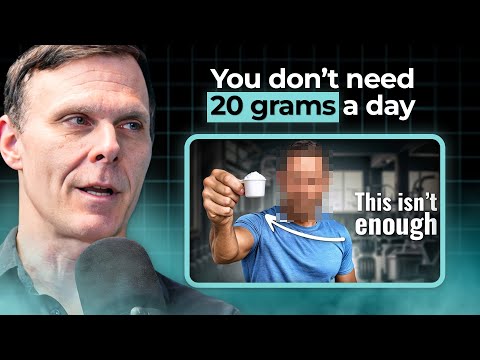
Sharing the latest Optispan podcast where Matt addresses high dose creatine recommendations from people like Rhonda Patrick…
3 Likes
CGPT5.1 Summary:
A. Executive Summary (≈200 words)
The episode is a critique of current creatine hype rather than a “pro–creatine” pitch. Matt Kaeberlein’s core position: creatine monohydrate at ~5 g/day, taken consistently and combined with resistance training, probably deserves a place in a “top 5 supplements” list, but the mega-dosing and miracle claims pushed by influencers are not supported by evidence.
On muscle and bone, meta-analyses show that creatine plus resistance training yields modest, incremental gains in lean mass and strength, especially in older adults, but it is not transformative, and higher chronic doses (>5 g/day) have not clearly outperformed standard dosing. ([PubMed][1]) Evidence for bone is mixed: some earlier small trials suggested benefit with RT, but a recent 2-year RCT in postmenopausal women found no added effect on bone mineral density, even with long-term creatine. ([PMC][2])
For cognition, short-term creatine (5–20 g) can improve certain memory and attention tasks, particularly in older adults and under stress or sleep deprivation, but effects are small and not stimulant-like; dose–response is weak, and 20 g/day is not clearly superior to 5 g/day. ([PubMed][3])
Claims that creatine reverses aging or meaningfully alters Parkinson’s disease, multiple sclerosis, or brain aging lack convincing human data; major Parkinson’s trials were stopped for futility. ([HealthPartners][4]) Safety is good at 3–5 g/day in healthy people, with GI upset and water retention the main issues at higher doses, and no clear signal of kidney damage or hair loss in modern trials. ([PMC][5])
The broader lesson: don’t treat creatine as a hack or a drug; treat it as a modest adjunct layered on top of sleep, diet, and resistance training.
B. Bullet Summary (12–20 standalone points)
- Creatine is heavily hyped in 2025, with influencers promoting mega-dosing and dramatic brain/aging effects that exceed the data.
- Kaeberlein places creatine in his “top 5” supplements but emphasizes modest effect sizes and the need for resistance training.
- Standard dosing of ~5 g/day creatine monohydrate with resistance training modestly improves lean mass and strength on average, especially in older adults. ([PubMed][1])
- Data on bone health are equivocal: some shorter trials with RT suggested benefit, but a 2-year RCT in postmenopausal women found no improvement in bone mineral density vs placebo. ([PMC][2])
- Influencers commonly imply “higher is better” (8–10 g/day for bone; 20 g/day for brain), but comparative data do not show clear superiority over 5 g/day. ([PubMed][3])
- Meta-analyses show creatine can improve memory and some cognitive tasks, with older adults and stressed/sleep-deprived individuals deriving the most benefit; young, healthy people often see little effect. ([PubMed][3])
- Dose, duration, sex, and geography do not strongly modify cognitive outcomes in pooled analyses, contradicting “20 g or nothing” narratives. ([PubMed][3])
- Small RCTs suggest creatine augments antidepressant therapy in major depressive disorder, but samples are tiny and sex-specific; this remains preliminary. ([PubMed][6])
- A large, multi-year Parkinson’s trial (>900 participants) showed no disease-modifying effect of creatine and was terminated for futility. ([HealthPartners][4])
- Multiple-sclerosis studies using 20 g/day short term did not meaningfully improve muscle performance or fatigue, and sometimes showed poor creatine uptake. ([University of Toledo][7])
- Claims that creatine feels “like speed” or is “on par with caffeine or nicotine” for focus are not supported by clinical data and conflict with most users’ experience.
- Mechanistically, creatine serves as substrate for phosphocreatine, a short-term ATP buffer; it is not itself a stimulant. ([MDPI][8])
- Kaeberlein stresses evaluating influencers by expertise, track record, and conflicts of interest—especially when they own the creatine brand they are promoting.
- Statements like “no downside” are flagged as inherently non-credible; everything that perturbs metabolism has some risk, however small. ([PMC][5])
- At 3–5 g/day, creatine has a strong safety record in healthy people; kidney function and hair loss concerns are not supported by modern trials. ([PMC][5])
- High doses (≥20 g/day) increase rates of GI symptoms and water retention; long-term safety of chronic mega-dosing is under-characterized. ([Healthline][9])
- The recommended practical strategy: 5 g/day creatine monohydrate, taken consistently, plus progressive resistance training, on top of foundational lifestyle factors (sleep, diet, social connection).
Full response here:
3 Likes
Agetron
#218
That’s my take 5 grams past 2 years… in coffee every morning… extra scoop in a small coffee, just before gym on my workout days  .
.
2 Likes