Notícias

RapAdmin

The journey begins!

I’ll use this thread to report my experience as my partner, my dog, and I begin taking Rapamycin (sirolimus).

BIO-INFO

I am 47 and weigh 180lbs. Using pre-rapa tests, my Aging.ai age was 49 and my Levine age was 43. I’m healthy and athletic. I lift weights twice a week for around 90 minutes each time, getting my heart rate up to 183 max between 5-10 times during the workout. I tend to be sensitive to medications. I am taking daily pills for hair retention: 1.25mg Minoxidil and 0.25mg Finasteride. I also take the following supplements somewhat regularly: D3, Magnesium, Zinc, Omega-3. I eat Kimchi daily as part of my lunch and eat prebiotic fiber daily with my oatmeal breakfast. Finally, I also just began making Kefir, which I have come to really enjoy.

My partner is 50 and healthy. She exercises vigorously daily. She weights around 130lbs. She takes daily multivitamins and a few of the same supplements I take. I would say she’s fit and I’m mostly fit. Unlike me, she does not have a delicate system.

My dog is 12 years old. She weighs 44lbs. She has mostly clear eyes, no physical problems, and sleeps a lot. When she wants it she has plenty of energy in reserve, like when the UPS truck drives past our house.

Leia Mais My DOG, My PARTNER, and ME: A Week by Week Rapalogue

RapAdmin

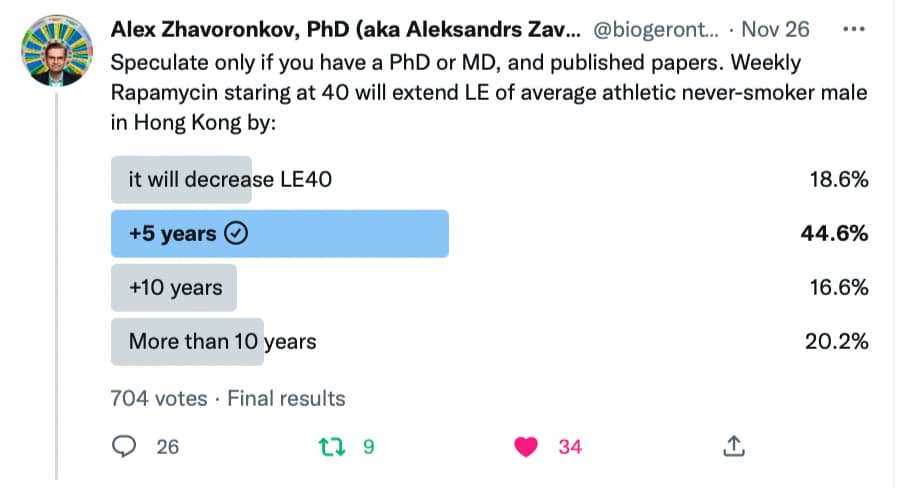
This is a good twitter poll of a reasonably large sample (about 700 at the time of writing) of longevity experts’ opinions on the Life Expectancy (LE) benefits of rapamycin. In this poll approximately 44.6% of the longevity experts forecast a 5 year increase in human lifespan with regular rapamycin use, 16.6% expect 10 years increase in lifespan, and 20% predict more than 10 years increase in lifespan.

Alex is a founder of one of the leading Longevity Drug/Biology of Aging conferences (AARD) and also founder/CEO of one of the most well-funded longevity biotech companies (Insilico Medicine, which has gained over $400 million in funding to date), and his twitter followers (of which he has over 16,000) include many (if not most) of the scientists, researchers and participants in geroscience field and the longevity biotech industry. So, Alex is one of the few people in the world who could post a poll like the one above and get 500+ geroscientists and longevity biotech researchers to respond to it.

This group is probably in the best position to understand the risks and potential benefits of rapamycin (and they are a significant portion of the early adopters of rapamycin). Almost 80% of these PHD/MD longevity experts predict significant lifespan and healthspan improvement (and "significant is defined here as somewhere between 5 years to 20 or 30 years increase) with weekly rapamycin. And, of course, rapamycin is just one of numerous drugs showing longevity benefits: New Paper: Lifespan Benefits for the Combination of Rapamycin plus Acarbose in mice

Related reading:

RapAdmin

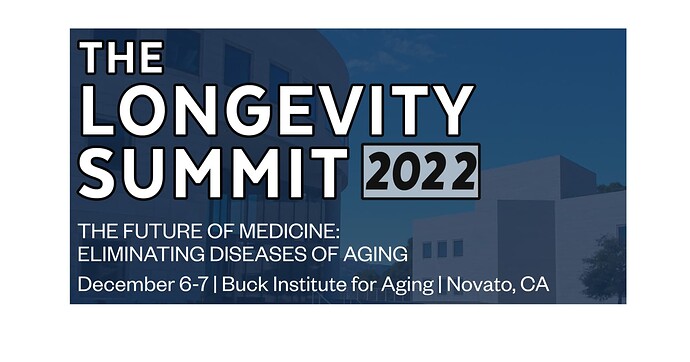
Two great Longevity-focused conferences are coming up in early December that you should try to attend if you are in Northern California around this time. I plan to attend both and report back on what I find most interesting and applicable. Let me know if you plan to attend either of these events.

December 6 and 7, The Buck Institute Longevity Summit.

We gather the entire longevity ecosystem to tackle the aging problem: longevity entrepreneurs, existing pharma and biotech companies, investors, researchers, and government organizations. Developing aging interventions may represent the largest value creation journey in human history, and it’s going to require a coordinated industry.

Price: $499 for the two days
Note: 20% reduction in price if you use the discount code “RapamycinNews”

Details at the website here: https://longevitysummit.io/
List of Speakers Here: Bermain Sport Games ? Javabetsport Solusi Maximal Untuk Mencoba !
Location: Buck Institute for Research on Aging, 8001 Redwood Boulevard Novato, CA 94945
If you haven’t been to the Buck Institute, check it out in this video: Buck Institute Tour

December 8th: Bay Area Aging Meeting (BAAM)

We covered this meeting earlier this year (they have two meetings a year). Attendance is free, and there are lot of great papers and poster sessions here. Highly recommended if you have a deep and scientific interest in the biology of aging.
BAAM Website Here: https://agingmeeting.org/
Register Here: Programs – My WordPress
Price: Free

For Details on the BAAM Meeting/Program, etc, go to this link: San Francisco Bay Area Aging Meeting (BAAM), December 8th Details, Join Us!

Thursday, December 8, 2022

Robertson Auditorium
Mission Bay Conference Center
UCSF Mission Bay Campus
1675 Owens Street
San Francisco, CA 94143

RapAdmin

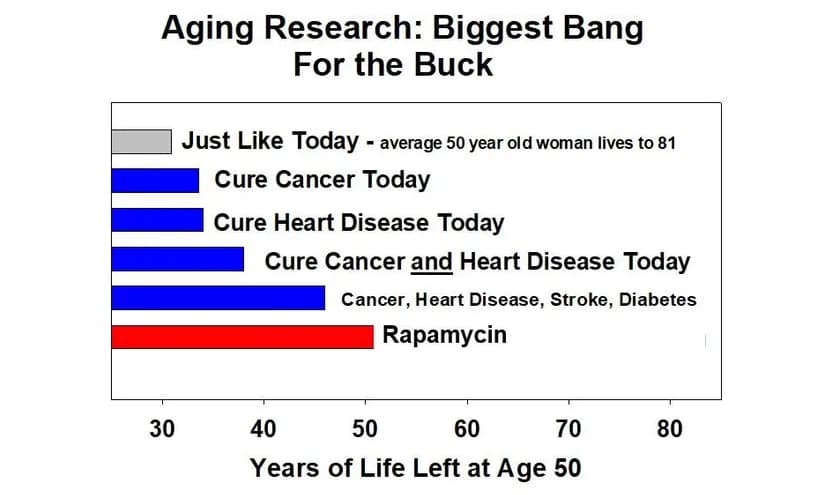
Richard Miller, the leader of the National Institutes on Aging Intervention Testing Program, has the above image on his lab website to emphasize the importance of research into the biology of aging, and the potential for age and disease prevention drugs like rapamycin (vs. the traditional “sick care” model focus of the NIH and US national healthcare system, in which they wait for disease to happen, and only then work on the care / disease of the patient). If rapamycin proves to be as effective in humans as it has been in mice, it will be a bigger impact than curing cancer, heart disease, stroke and diabetes. This is because, even if these cures were found, there are many other diseases that people would succumb to. By comparison the benefit of a preventative, age-slowing strategy such as may be possible with rapamycin, would delay all age-related diseases.

At Rapamycin News we believe the primary focus should be on prevention of disease (by slowing aging), and the data quite clearly show that this would provide the greatest benefit to the most people. Somehow the old adage of our grandparent’s age that “A ounce of prevention is worth a pound of cure” has been lost, and virtually all of the NIH budget of $49 Billion a year is spent on trying to identify that “cure”, while ignoring the role of prevention. This has to change as the global society ages.

The typical rapamycin user here pays perhaps $30 to $60 per month for their rapamycin (or approx. $7,000 to $14,000 for 20 years of rapamycin), and if the results seen in mice and other organisms transfers to humans then we can expect an additional 20 years of disease free healthspan and lifespan. Compare that to the $13,600 cost per day to stay in the typical US hospital and the economic benefits (to say nothing of the social benefits) are clear. If rapamycin keeps a person out of the hospital for just 1 day over 20 years, then the healthcare system as a whole is at break-even point. The potential for healthcare system savings of drugs like rapamycin is monumental given the annual national healthcare expenditures in the USA of $3,453 billion. The savings are even more immediately realizable in all the developed countries of the world that have national healthcare systems (Canada, Europe, Japan, etc. - every country other than the USA) because the single payer (the government) reaps the rewards/savings from disease prevention.

The National Institute on Aging sponsors the multi-institutional “Interventions Testing Program,” or ITP, to evaluate agents, such as drugs or nutriceuticals, that might slow aging and extend healthy lifespan in mice. The initial protocol focused on lifespan as the key endpoint. Agents that pass this screen are then evaluated in follow-up studies that include a wide range of age-sensitive tests, mid-life pathology, and ideas about mechanism of effect. More information about the program can be found here,including a list of drugs tested or in progress, links to tissues that can be provided for collaborations, and information about how to propose an intervention. Published work has documented major benefits from treatment with rapamycin, acarbose (males > females), and 17a-estradiol (males only), and smaller but significant benefits from three other agents (NDGA, Protandim, glycine).

For more information see: Drugs that Slow Aging (ITP)

RapAdmin

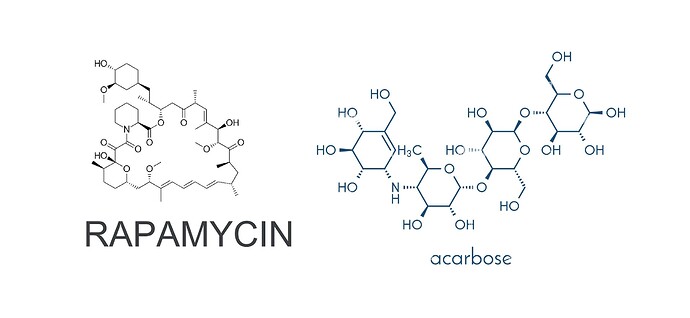
More good news on Rapamycin and Acarbose in this mouse study just published (Nov, 2022):

Acarbose (ACA) or Rapamycin (RAP) treatment improve rotarod acceleration and endurance capacity compared to controls, with effects that are largely similar in mice starting treatment from early or late in life. Compared to controls, cardiac hypertrophy is reduced by ACA or RAP in both sexes regardless of age treatment onset. ACA has a greater effect on the cardiac lipidome than RAP, and effects of early life treatment are recapitulated by late life treatment. These results indicate that late life treatment with these drugs provide at least some of the benefits of life long treatment, although some of the benefits occur only in males, which could lead to sex differences in health outcomes later in life.

Paywalled Paper:

https://academic.oup.com/biomedgerontology/advance-article-abstract/doi/10.1093/gerona/glac221/6808972?login=false

Leitura Relacionada: Acarbose - Details On Another Top Anti-Aging Drug

Interestingly, one of the paper’s authors, Sean Louzon, published a 44 page thesis (attached below) on a similar topic a few years ago. His evaluation in his thesis of the rapamycin side effects is poorly informed and seems to have missed the benefits of pulsed dosing that people do in longevity applications. So, at least in his Thesis, his comments on rapamycin are unnecessarily negative.

Conclusion

This thesis has demonstrated that Acarbose, in addition to extending lifespan, also ameliorates age-associated deficits in motor function and reduces left ventricular hypertrophy in males. These age-related effects could potentially be due to changes in cardiac metabolism with aging.

lousean.pdf (2.0 MB)

RapAdmin

This is an opportunity for you to exercise your creativity. As you know, rapamycin is a now a cheap generic medication that will never again have a pharmaceutical company clinical trial budget, or marketing programs to help get the word out about its health and longevity properties. Our primary focus here is the science of longevity, but research also suggests that a sense of humor is linked to greater longevity.

So, I thought it would be fun for us to contribute our own ideas for rapamycin memes. Think about what might, either now or at some time in the future, be good tag lines, serious or parody advertisements, memes, or other humorous commentary on rapamycin and the implications of its use for longevity.

Please add your comments, edited photos, tag lines, and ideas below in the comments! Have some fun! Feel free to “borrow” ideas from other companies and prior advertising programs and tweak as needed. This is just for fun.

“Like” the designs you prefer, and the most popular posts / winner gets to choose their very own tag line to go with their screen name.

Click here and scroll to see all the Memes: Rapamycin Meme Ideas

RapAdmin

I was listening to the “Live Long and Master Aging” podcast during my morning workout and learned about a recent special report on life extension drugs in the Biotech/Pharma news website “BioWorld”. This podcast is here: https://www.youtube.com/watch?v=P-_VDhEiovA
But the actual BioWorld Insider Podcast is much better and more indepth (see below).

This led me to the BioWorld website and their recent report on aging “Extending the human lifespan” (Paywall)

They have a two week free trial of the site - so I signed up for that so I could see and read their entire report (and plan to cancel before the end of the two weeks, since the $4,000/year subscription is a tiny bit more than I want to pay). I think the podcast they published on this report may be available to everyone and I highly recommend it (see link below). It covers many of the implications of Longevity Drugs that most other sites don’t mention:

In Extending the human lifespan, a BioWorld special report, the team examined the latest science, the key biological drivers that can be targeted pharmacologically and the companies developing potential “Fountain of Youth” candidate drugs. In this episode of the BioWorld Insider Podcast, the team discussed the report’s highlights and key takeaways. In what could be a holy grail for humanity, anti-aging drugs would simultaneously reduce the risk of multiple age-related illnesses in one. BioWorld found that investments in life-extending drugs and the number of clinical trials are on the rise. Can we hopscotch over the many diseases of aging? The impact could be staggering. Equitable access to drugs and therapies tackling aging could reduce health care costs in a major way and improve quality of life.

BioWorld Insider Podcast

I think anyone can listen to this. Its a good overview of the articles. Let me know if you have problems accessing the podcast link here: BioWorld “Extending the human lifespan” Podcast

In their special report (which in reality is just a series of seven short news items, each about 1 page or 500 words), they cover the following areas:

Extending the human lifespan: Aging is not an endpoint – new regulatory, reimbursement approaches needed, July 18, 2022 By Mari Serebrov

With classes of anti-aging drugs already in the pipeline, “the biggest hurdle is FDA approval. Then reimbursement,” George Kuchel, a professor and director of the UConn Center on Aging at the University of Connecticut, told BioWorld. To succeed, developers of these drugs will need to find a regulatory sweet spot, he added.

That could require a change in law and regulations. Under its charter, Kuchel said, the FDA has the legal authority to approve drugs that are defined as substances “intended for use in the diagnosis, cure, mitigation, treatment or prevention of disease.” Unless aging is accepted as a disease, that definition could pose a challenge for an aging indication in the U.S.

Extending the human lifespan: When big dreams meet big money, can science stay first-rate?, July 18, 2022, Anette Breindl

In the biopharma industry, the sirtuins have been a cautionary tale of some of the challenges in translating aging research.

Research in the early aughts suggested that activating them could extend lifespan, and the spectacular rise of sirtuin activators crested in 2008, when GSK plc bought preclinical startup Sirtris Pharmaceuticals Inc. to the tune of $720 million, only to shutter it a few years later.

But the hopes attached to sirtuin activators – especially resveratrol, which spurred its own cottage industry of supplements as well as dietary advice to drink red wine and eat dark chocolate – have not panned out.

The idea of getting enough resveratrol to boost lifespan through the diet was, ironically, short-lived. For red wine, “to any get positive effects of resveratrol, you would have a drunken mouse day in and day out for a very long time,” Francesca Macchiarini, scientific officer at the U.S. NIH’s National Institute on Aging (NIA), told BioWorld.

Extending the human lifespan: Beyond rapalogs and metformin, moonshots at the Fountain of Youth, July 18, 2022, Anette Breindl

A lot of what goes on during aging remains too poorly understood for straightforward translation.

There are hallmarks of aging, and researchers are getting a handle on its biological mechanisms. Nutrient sensing has repeatedly been implicated, as have inflammation and oxidative stress. Senescence is the newest belle of the aging ball.

But in a basic sense, “we still don’t have much of an idea what causes aging,” Björn van Eyss told BioWorld. Van Eyss is a cancer researcher whose scientific home is the Leibniz Institute for Aging Research in Jena, Germany.

Extending the human lifespan: For preventing aging, some decades old drugs?, July 18, 2022, Anette Breindl

In one sense, aging is indeed inevitable. We are all a day older today than we were yesterday.

But the best available data suggest that many of the diseases that come with aging could be avoided – that it is possible, in the words of American Federation for Aging Research (AFAR) scientific director Nir Barzilai, “to die young at a very old age.”

The U.S. NIH’s National Institute on Aging’s Intervention Testing Program (ITP) has been searching for ways to extend lifespan for more than two decades by now. And in its animal studies, it has been successful multiple times.

Increasing lifespan: ITP success stories, by sex

The National Institute on Aging’s Interventions Testing Program (ITP) is a multi-institutional study investigating treatments with the potential to extend lifespan and delay disease and dysfunction in mice. Seven compounds have shown significant extension of median lifespan.

  • Aspirin - Increased lifespan in males but not females.
  • Rapamycin - Increased mean and maximal lifespan in both males and females when initiated at 20 months of age and when initiated at 9 months of age. Females responded more robustly than males at equivalent doses; when ~ equal blood levels were achieved, response was also about equivalent in females and males.
  • 17αEstradiol - Increased lifespan in males but not females, at 4.8 ppm dose and 14.4 ppm dose.
  • Acarbose - Increased lifespan in both males and females, but the effects were greater in males, when initiated at 4 months of age, but only males responded when initiated at 16 months of age.
  • NDGA (nordihydroguaiaretic acid) - Increased mean lifespan in males but not females, even at doses that gave equivalent blood levels in males and females.
  • Glycine - Started at 9 months. Increased lifespan in males and females.
  • Protandim - Increased lifespan in males but not females.

Extending the human lifespan: Preventing worse inequities

Altos Labs Inc. reportedly attracted Amazon founder Jeff Bezos as an investor when it launched in early 2022, with an eye-popping $3 billion in funding. That inevitably led to suggestions that biopharmas are looking to make billionaires immortal. According to companies that specialize in funding research into aging, the idea is to encourage health care systems and payers to evolve and focus more on preventing ill health.

Nevertheless, there are important ways in which anti-aging research has the potential to make existing inequities worse.

For example, there is a clear risk of anti-aging approaches exacerbating gender differences in healthspan.

Extending the human lifespan: Live long and prosper? Science says you can

To most people, trying to prevent aging seems like a dream – maybe a pipe dream, in fact. But a dream for sure.

To aging researchers, it seems like common sense. And if animal studies are any indication, maybe not that hard, either.

James Peyer, CEO of Cambrian Biopharma Inc., told BioWorld that “the field has been done a disservice by the conflation of two things – what these drugs could actually do for patients…. And the philosophical, sci-fi obsession that mankind has had with slowing aging.”
RapAdmin

It is great to see VitaDOA finally covering rapamycin in greater depth. VitaDAO is a community-owned collective funding early stage longevity research. They fund and help commercialize longevity therapeutics.

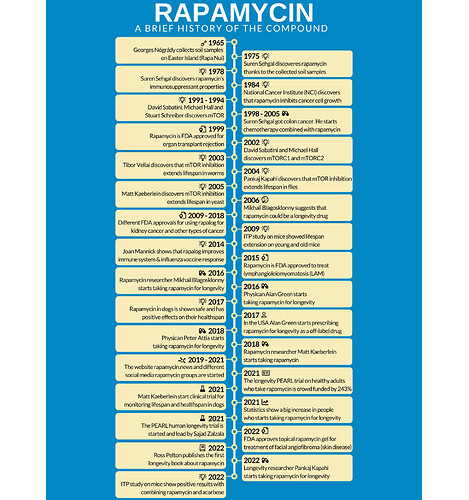
It was in 1975 when scientists from Ayerst (now Pfizer) discovered a novel compound called rapamycin (also known as Sirolimus) in bacteria on Rapa Nui (Easter Island) in Chile. In 1999 rapamycin obtained FDA approval for the prevention of acute rejection of renal transplant. Unknown at the time, rapamycin would become the most potent anti-aging drug that humans currently hold.

This is the first article of a two-part series on rapamycin.

Read the Full Article at This Link Below:
VitaDOA: Rapamycin is the most promising aging intervention we currently have

Krister_Kauppi

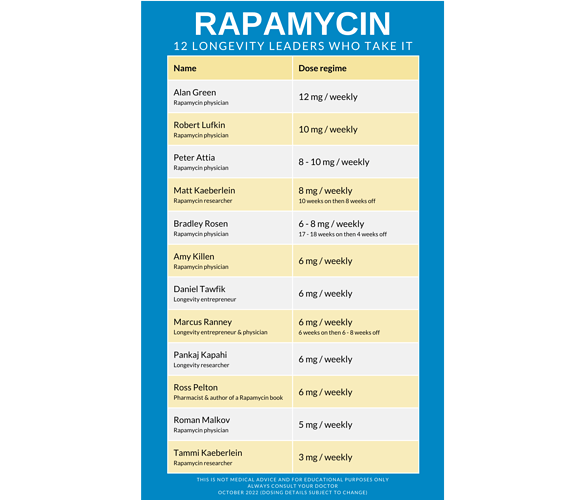
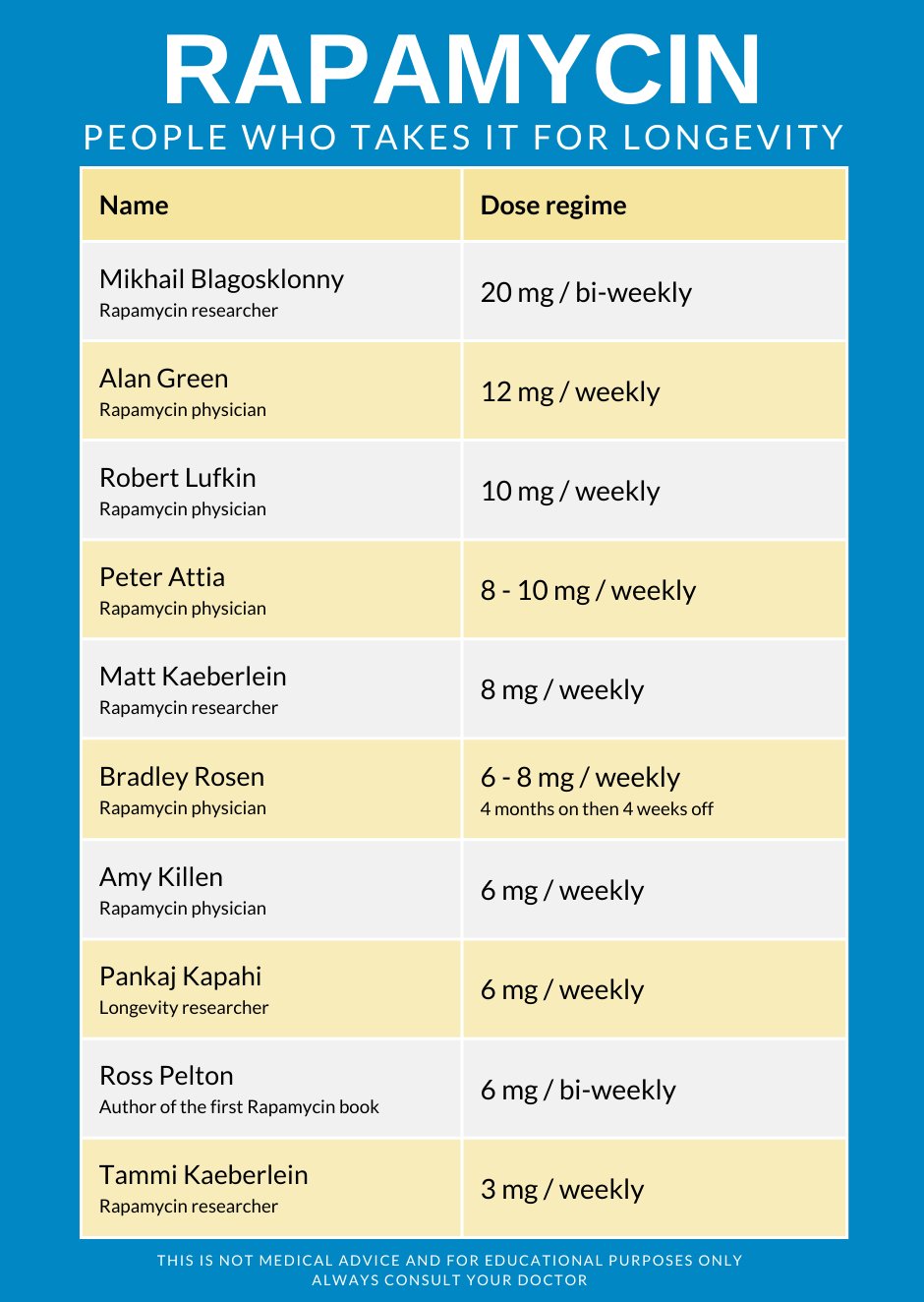
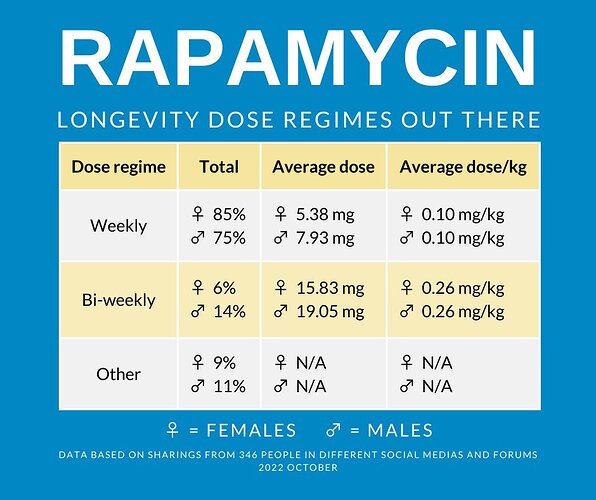
Here is a snapshot summary of 10 longevity leaders who take rapamycin and their dosing. See also the in-depth post on Longevity Leaders who are taking rapamycin. Have I missed someone? One interesting thing is that most take it weekly and the average weekly dose for females (4.5 mg) and males (8.66mg) is good aligned with the statistics what 346 people are also doing (5.36mg and 7.93mg - see previous post)

Additional Rapamycin Information Summaries