Part 3: Actionable Intelligence
Actionable Intelligence (Deep Retrieval & Validation Mode)
The Translational Protocol (The “COSMOS” Stack): While the paper focuses on clocks, the underlying trial (COSMOS) tested a specific, accessible stack. If you aim to replicate the intervention associated with potential benefits in this cohort:
-
Multivitamin (MVM):
-
Human Equivalent Dose (HED): 1 tablet/day.
-
Source: Centrum Silver (used in the trial).
-
Mechanism: Micronutrient sufficiency to prevent “triage theory” aging (where the body sacrifices long-term repair for short-term survival due to vitamin deficits).
-
Cocoa Extract:
-
Human Equivalent Dose (HED): 500 mg/day Cocoa Flavanols.
-
Key Active: 80 mg (-)-epicatechin.
-
Safety Note: Contains ~50 mg Theobromine.
-
Pharmacokinetics (PK/PD):
-
Epicatechin: Peak plasma concentration (Cmax) occurs ~1–2 hours post-ingestion. Half-life is short (~2–4 hours), suggesting divided doses or timed intake might be optimal, though the trial used a single daily dose.
-
Safety & Toxicity Check:
-
MVM: Generally Recognized As Safe (GRAS). Warning: Avoid if you have hemochromatosis (iron accumulation) or Wilson’s disease (copper).
-
Cocoa/Theobromine:
-
NOAEL: ~250 mg/kg/day in rats (very high).
-
Toxicity: Theobromine is toxic to dogs but safe in humans at this dose (50 mg is equivalent to < 1/10th of a dark chocolate bar).
-
Contraindications: Caution with severe GERD (reflux) or stimulant sensitivity.
Biomarker Verification Panel (How to actually test):
-
Efficacy Markers (Beyond the Clock):
- Don’t rely solely on Horvath/GrimAge for <2 year intervals.
-
Cocoa Response: Measure Flow-Mediated Dilation (FMD) or Systolic Blood Pressure (reduction validates endothelial NO production).
-
MVM Response: Serum Homocysteine (reduction indicates B-vitamin methylation support) and hsCRP.
-
Feasibility & ROI:
-
Cost: Low. MVM (~$15/month) + Cocoa Extract (~$20-$40/month).
-
Value: High. MVM showed statistically significant cognitive and memory benefits in parallel COSMOS publications (COSMOS-Mind), offering a better verified ROI than many exotic peptides.
Part 4: The Strategic FAQ
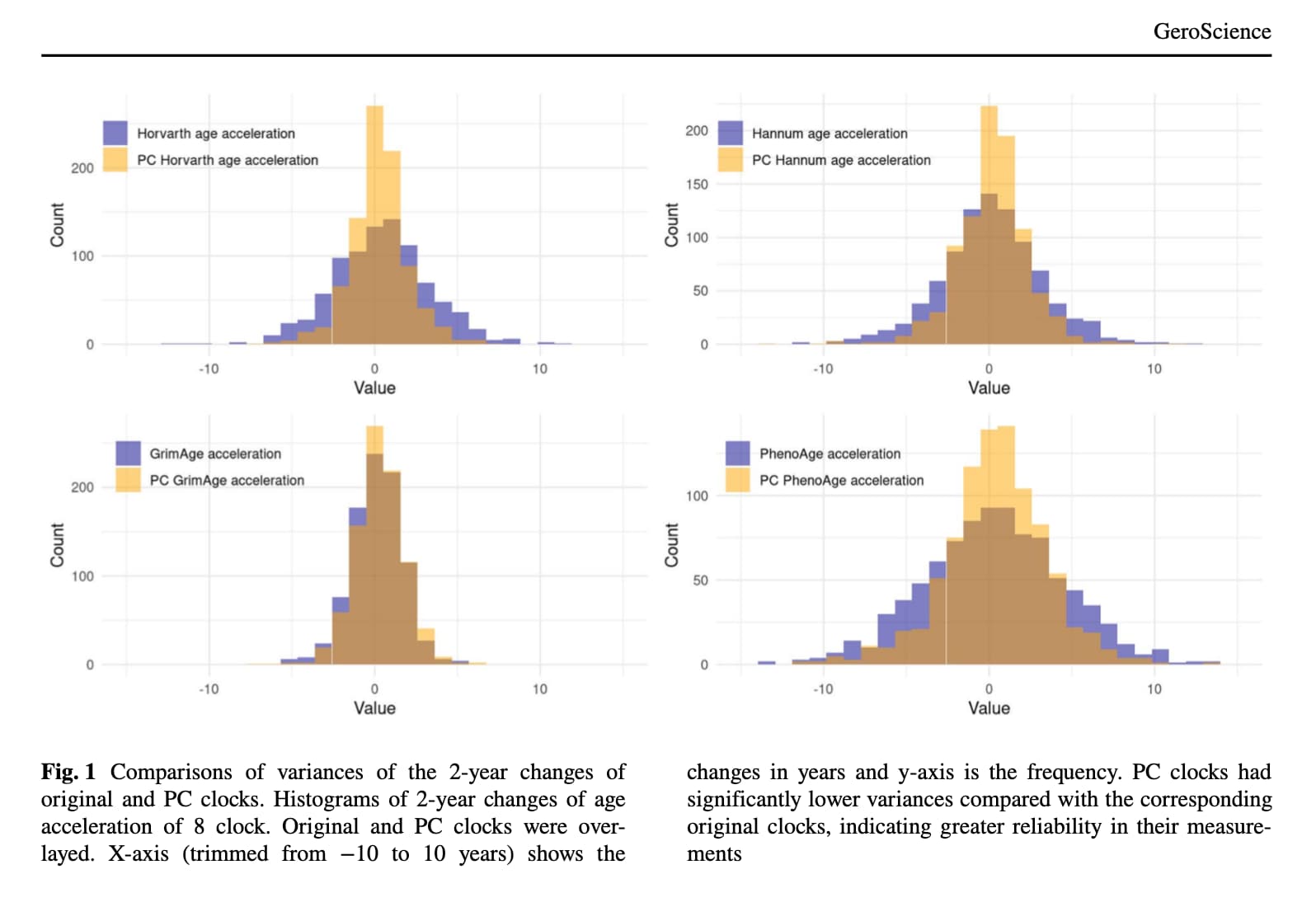
1. “If these clocks are so stable, why did my Biological Age drop 5 years after my last detox?” Answer: You likely experienced “Regression to the Mean” or technical noise. This paper shows that large fluctuations often correct themselves in the subsequent year without intervention. Be skeptical of volatility.
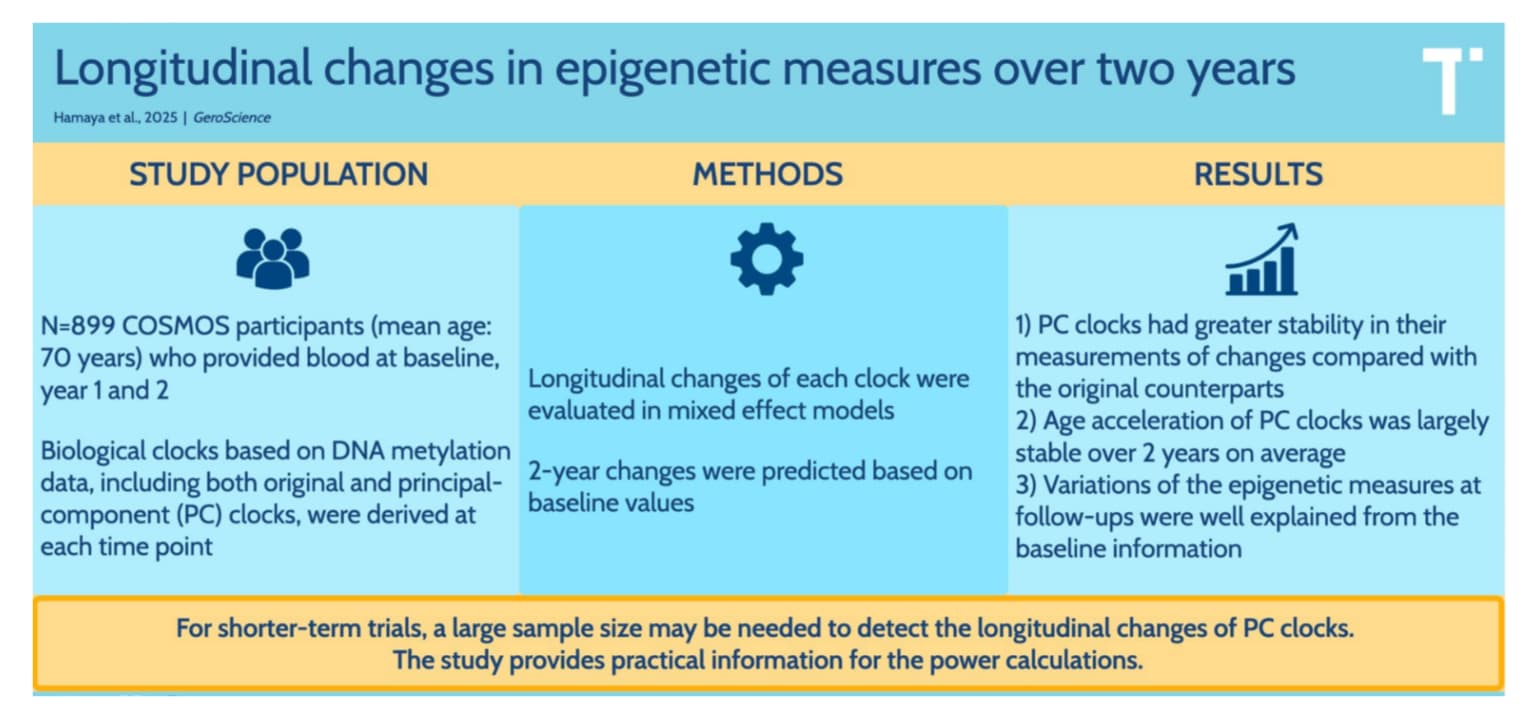
2. “Does this mean Multivitamins don’t work for longevity?” Answer: No. In fact, a separate abstract from this same COSMOS group (AHA 2025) reported that the Multivitamin group did slow aging significantly (-0.11 to -0.2 years/year) on PCGrimAge. The current paper highlights that this signal is small relative to the noise, requiring large sample sizes to detect. N=1 verification is unlikely to be statistically valid.
3. “Should I stop using the original GrimAge and switch to PC-GrimAge?” Answer: Yes. The study confirms PC (Principal Component) clocks have substantially lower variance and higher test-retest reliability. If you are paying for a test, ensure it uses the PC algorithm.
4. “Is 2 years really too short to measure aging?” Answer: For healthy people, yes. The biological noise of daily life dominates the subtle “aging signal” over 24 months. You need either a more potent intervention (e.g., Rapamycin, which has stronger animal data) or a longer observation window.
5. “Does Cocoa Extract work for methylation?” Answer: Data Absent/Neutral. The primary COSMOS outcomes for Cocoa were cardiovascular (reduced CVD death by 27%). The epigenetic benefits appear more tied to the Multivitamin arm (micronutrient density) than the Cocoa arm in preliminary reports.
6. “Can I just eat Dark Chocolate instead of the extract?” Answer: Difficult. To get 500mg of flavanols and 80mg epicatechin, you would need to consume highly specific, non-dutched (non-alkalized) high-flavanol chocolate. Standard dark chocolate varies wildly in flavanol content. Extracts provide the precision required for the clinical effect.
7. “Are there interactions between Cocoa/MVM and Rapamycin?” Answer: Minimal. Rapamycin acts on mTOR; MVM/Cocoa act on micronutrient status and endothelial eNOS. There are no known CYP3A4 conflicts (the enzyme that metabolizes Rapamycin) with standard MVM or Cocoa flavanols.
8. “Why did DunedinPACE not change?” Answer: DunedinPACE measures the “speed of aging” at a single point. The fact that it didn’t change implies the participants’ rate of decay remained constant. To “biohack,” you want to lower this number. Its stability suggests standard supplements (MVM/Cocoa) might not be potent enough to downshift the rate of aging in this demographic.
9. “What is the specific brand used in the study?” Answer: Centrum Silver (Pfizer) and a proprietary cocoa extract provided by Mars Edge (containing 600mg flavanols/day in the main trial, noted as 500mg in some sub-studies).
10. “If I can’t trust the clock, what should I measure?” Answer: Functional metrics. VO2 Max, Grip Strength, Cystatin C (kidney), and ApoB remain the gold standards for healthspan. Use epigenetic clocks as a 3-5 year “long view” metric, not a quarterly report card.