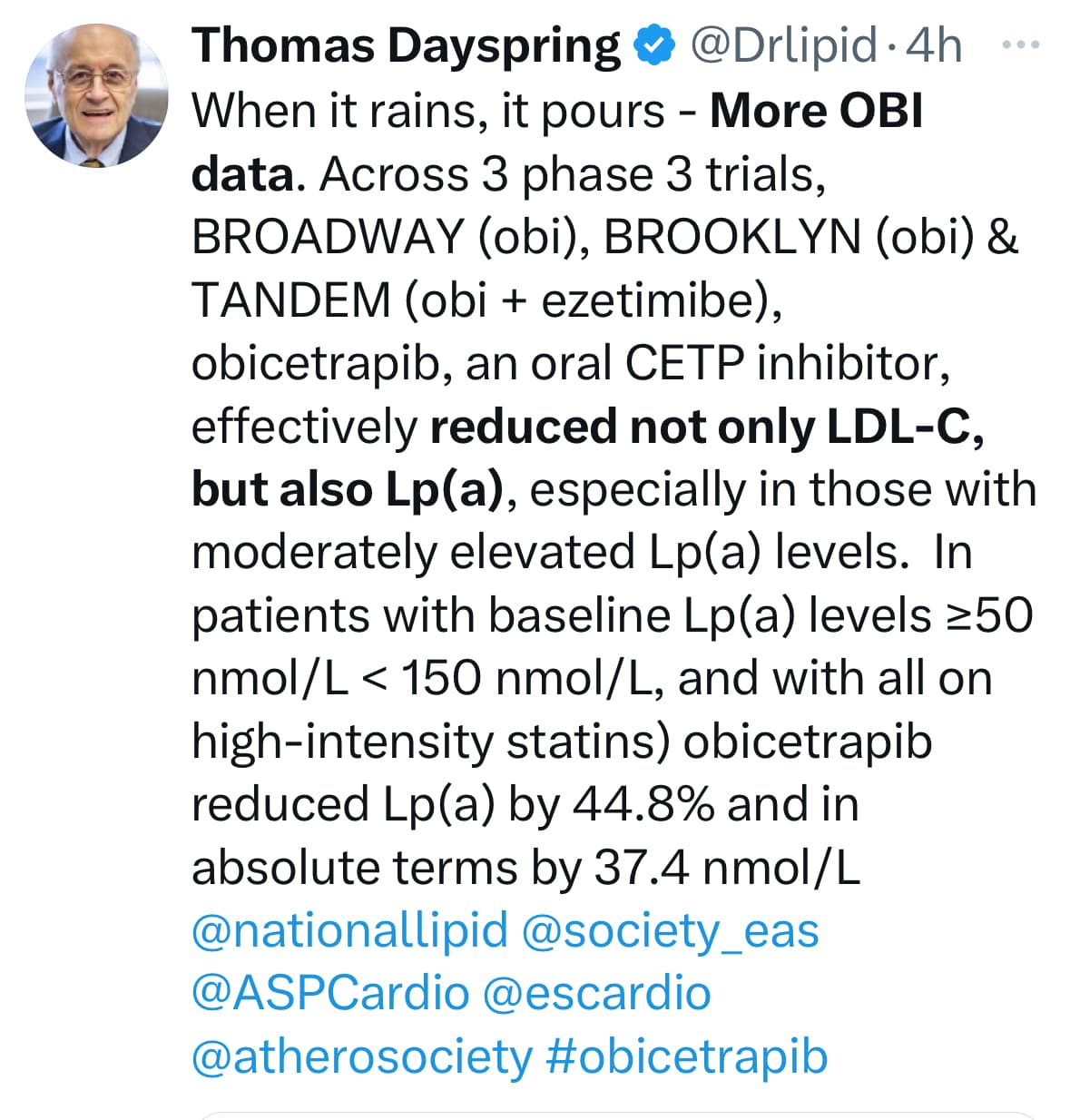
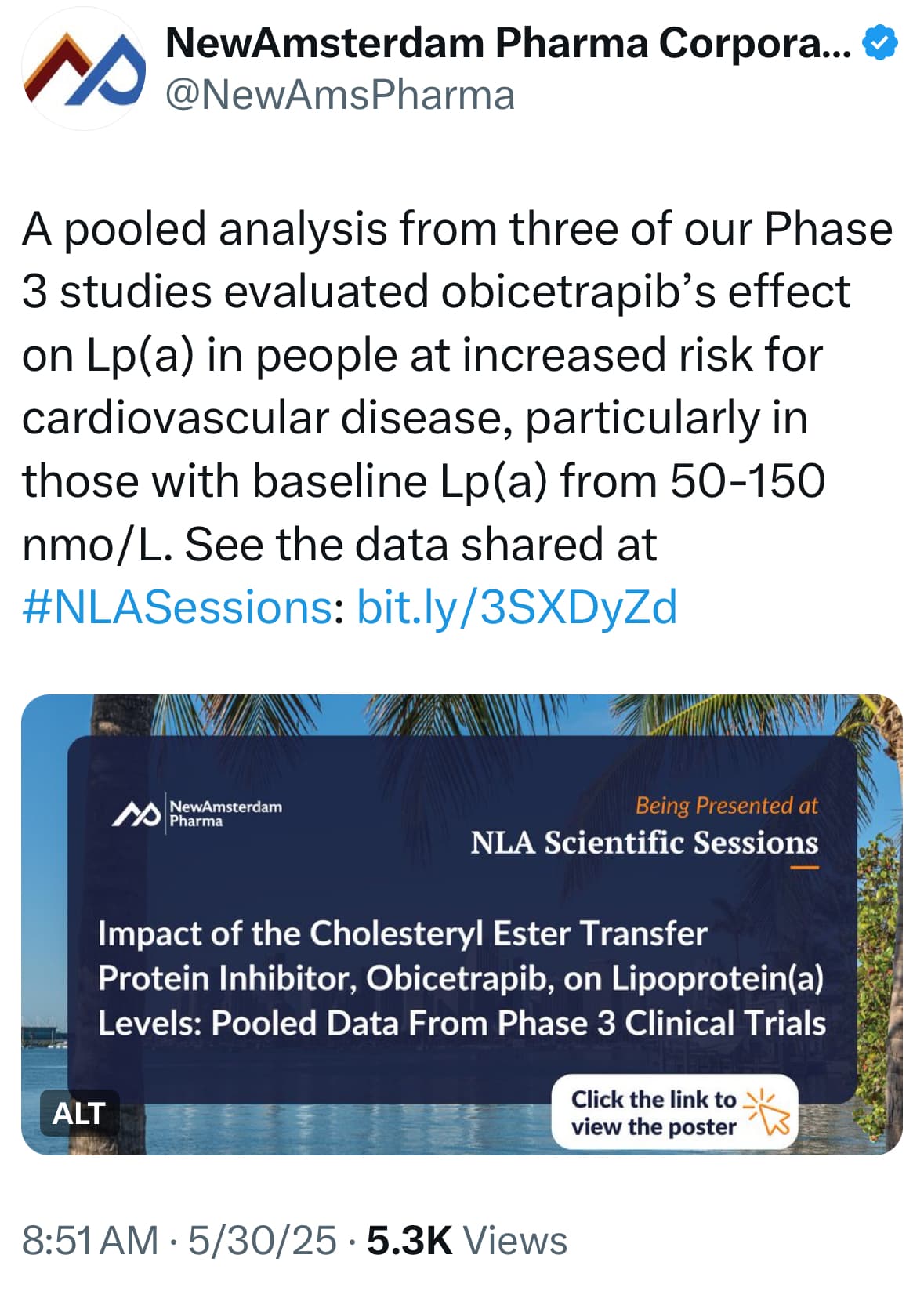
Lipoprotein(a) levels and what to do about them is the subject of this forum. My Lp(a) level runs about 160 nmol/L … so higher than I would like, but I don’t want to pay for PCSK9i etc meds. I recently came across an interesting 2021 JACC article (hsCRP Modifies the Cardivascular Risk of Lp(a) a Multi-Ethnic Study of Atherosclerosis by Wei Zhang, MD et al JACC 2021,V78,1083-1094 ) which concludes:
Lp(a) associated ASCVD risk is observed only with concomitant elevation of hsCRP >2.
The implication is that those with elevated Lp(a) should do all they can to lower their hsCRP.
Aside from exercise, good diet and appropriate supplements - Vitamin C and Lysine if you believe Linus Pauling, Statins will lower your hsCRP, at much less cost than PCSK9i etc meds. Note that the anti-inflammatory benefit of Statins is likely why they have been reported to have greater benefit than their cholesterol lowering effect would suggest.
2 Likes
The paper you are referencing, I believe is this:
High-sensitivity C-Reactive Protein Modifies the Cardiovascular Risk of Lipoprotein (a): Multi-Ethnic Study of Atherosclerosis
That is certainly an interesting paper.
Here is another paper, with an interesting quote:
ApoB-containing lipoproteins: count, type, size, and risk of coronary artery disease
https://academic.oup.com/eurheartj/advance-article/doi/10.1093/eurheartj/ehaf207/8118996
Quote:
“Correlations between inflammatory markers and lipoprotein measures are depicted in Supplementary data online, Figure S2 . HsCRP had a weak positive correlation with VLDL (ρ: 0.17 to 0.25) and LDL subclasses (ρ: 0.09 to 0.13). In contrast, glycoprotein acetyls displayed moderate positive correlations with VLDL (ρ: 0.43 to 0.62) and LDL (ρ: 0.37 to 0.46) subclasses. Lp(a) showed no correlation with either inflammatory biomarker (ρ: 0.00 to 0.03).”
Quote:
“In the variance-standardized model, 1-SD higher (72 nmol/L) Lp(a) count was associated with a 20% higher risk of CAD (HR 1.20, 95% CI 1.18–1.22, Figure 4 and Supplementary data online, Figure S4 ). This association remained essentially unchanged after adjusting for apoB-P (HR 1.18, 95% CI 1.16–1.20). When expressed as a 100 nmol/L increase, the per-particle risk of CAD associated with Lp(a) was 3.3-fold higher risk than the per-particle risk for an equimolar increase in apoB. We found no evidence of a multiplicative interaction between Lp(a) and apoB-P (P = .52). Sensitivity analyses involving adjustment of Lp(a) for conventional apoB-P measurements yielded similar findings to the main analysis (see Supplementary data online, Table S12 ).”
1 Like
As your ApoB reference points out, hsCRP levels do not alter measured levels of Lp(a)
No surprise there.
Alternatively the JACC reference implies that hsCRP levels change the reactivity of the Lp(a) moieties present.
Lower hsCRP implies less reactive Lp(a), not quantitatively less Lp(a)
Less reactive Lp(a) implies lower ASCVD risk.
2 Likes
Here’s a commentary on the Zhang study you referenced:
High-Sensitivity CRP Modifies the CV Risk of Lp(a)
"Perspective:
The findings are derived from baseline lipids and limited to low-risk persons without CVD with an average age of 62 years who had an annual CVD event rate including strokes of about 1% over nearly 14 years. Since the findings were independent of other known CVD risk factors, when either Lp(a) or hsCRP is elevated, it is reasonable to assess the other, and when both are elevated, consider more aggressive ASCVD management. But much needs to be done prior to incorporating the strategy into guidelines."
2 Likes
Lipoprotein(a), C-Reactive Protein, and Cardiovascular Risk in Primary and Secondary Prevention Populations
https://jamanetwork.com/journals/jamacardiology/fullarticle/2814836
" Question Is higher lipoprotein(a) (Lp[a]) associated with increased cardiovascular risk independent of baseline high-sensitivity C-reactive protein (hs-CRP) level?
Findings This cohort study found in both a primary prevention population (UK Biobank) and secondary prevention populations (FOURIER [TIMI 59] and SAVOR-TIMI 53), higher Lp(a) was associated with increased risk of major adverse cardiovascular events, myocardial infarction, and peripheral artery disease regardless of baseline hs-CRP level.
Meaning In both primary and secondary prevention populations, higher Lp(a) was associated with increased cardiovascular risk independent and regardless of hs-CRP*."
1 Like
IL-6 may be even more important in this context than hsCRP:
Inflammation, Lp(a) and cardiovascular mortality: results from the LURIC study
“Participants were predominantly male, with a mean age of 62.6 years. Extremely high Lp(a) (> 100 mg/dL) was associated with increased cardiovascular mortality (HR 1.5, 95% CI 1.06-2.12) compared to Lp(a) < 50 mg/dl. Both hsCRP (> 2 mg/L, HR 1.39, 95% CI 1.08-1.79 third vs. first interval) and more so IL-6 (HR 1.92, 95% CI 1.64-2.23, upper vs. lower half), were independently associated with higher CVD mortality. While hsCRP did not increase the Lp(a)-CVD mortality in stratified analysis, high IL-6 conferred an increased risk at Lp(a) levels > 100 mg/dL (HR 1.25, 95% CI 1.09-1.44).”
More on IL-6
[Interleukin-6 modifies Lipoprotein(a) and oxidized phospholipids associated cardiovascular disease risk in a secondary prevention cohort]
(https://www.atherosclerosis-journal.com/action/showPdf?pii=S0021-9150(25)00109-1)
[Top 10 Lifestyle Behaviors to Reduce IL-6 and Inflammation]
(https://www.il-6.ai/post/top-10-lifestyle-behaviors-to-reduce-il-6-and-inflammation)
1 Like
Lipoprotein(a) and recurrent atherosclerotic cardiovascular events: the US Family Heart Database
https://academic.oup.com/eurheartj/advance-article/doi/10.1093/eurheartj/ehaf297/8124887?login=false
“Lipoprotein(a) levels were higher in women vs men and in Black vs Hispanic and White individuals. During a median follow-up of 5.4 years, 41 687 individuals (15%) experienced recurrent ASCVD. Higher lipoprotein(a) levels were associated with continuously increasing risk of recurrent ASCVD. Compared to individuals with lipoprotein(a) < 15 nmol/L, the adjusted hazard ratios for recurrent ASCVD events were 1.04 (95% confidence interval 1.01–1.07) for 15–79 nmol/L, 1.15 (1.12–1.19) for 80–179 nmol/L, 1.29 (1.25–1.33) for 180–299 nmol/L, and 1.45 (1.39–1.51) for ≥300 nmol/L. Results were similar for individual ASCVD components, and in sex, race/ethnicity, baseline ASCVD, and diabetes subgroups; however, high impact LDL cholesterol-lowering therapy possibly mitigates the deleterious effect of lipoprotein(a) ≥ 180 nmol/L, most pronounced in those on PCSK9 inhibitors. Interaction on recurrent ASCVD events between lipoprotein(a) categories and sex, race/ethnicity, baseline ASCVD, diabetes, and impact of LDL cholesterol-lowering therapy use had P-values of .61, .06, .33, .91, and 2 × 10⁻⁸, respectively.
Conclusions
In 273 770 individuals with ASCVD, higher lipoprotein(a) levels were associated with continuously increasing risk of recurrent ASCVD events regardless of sex and race/ethnicity that may have been partially mitigated by high impact LDL cholesterol-lowering therapy.“
3 Likes
This is such great news! My Lp(a) was 40 and I was freaked out, even though CAC was 0.96 and I am metabolically healthy, BMI of 18.6. Have been on Repatha for a couple of years, and Ezetimibe too. Reduced Lp(a) to 27 and APOB also reduced. Did raise blood glucose some. Had been thinking of titrating off the Repatha and maybe also the Metformin. This latest information has really helped me move toward that decision. Suggestions / reactions would be welcomed!
3 Likes
My Lp(a) is 187. I am very thin (weigh 53 kg) so that is good news as my waist to him is good. Interesting aside- I had very high cholesterol past few years (subclinical hypo maybe caused it but I cant tolerate levo). A few months ago I started taking berberine one third of the dose suggested on the bottle (Natures Sunshine in Australia) and not every day. My latest blood test shows cholesterol in normal range- my doctor persobnally called me to ask what I was doing. Only other thing is we bought a water rowing machine and I do ten mins a day on that.
3 Likes
Thanks for sharing! This is super interesting. I clicked through to the paper and it does seem that the study was done in a reasonable way:
Methods: 4652 participants from the Multi-Ethnic Study of Atherosclerosis (MESA) were grouped as follows: Lp (a) <50 mg/dl and WHR <90th percentile(pct) (reference); Lp(a) <50 mg/dl and WHR ≥90th pct; Lp(a) ≥50 mg/dl and WHR <90th pct; and Lp(a) ≥50 mg/dl and WHR ≥90th pct.
Here, I wish they’d use a different cut-off. Here, 49mg/dl would be considered as “normal” when I would still call that elevated. I’d love to see the association in the <20mg/dl range, which I think is a majority of people.
Cox proportional hazard models assessed the relationship of Lp(a) and WHR with time to ASCVD events.
Results: Compared to the reference group, isolated elevated Lp(a) ≥50 mg/dl or WHR ≥90th pct were not significantly associated with risk of ASCVD (hazard ratio (HR), 1.15, 95 % confidence interval (CI): 0.94–1.39) and (HR, 1.14, 95 % CI: 0.92–1.41), respectively. In contrast, the combination of elevated Lp(a) ≥50 mg/dl and WHR ≥90th pct was associated with ASCVD risk (HR, 2.34, 95 % CI: 1.61–3.40).
Lp(a) ≥50 mg/dl was not significantly associated with ASCVD risk in the 1st and 2nd tertile of WHR (HR, 1.06, 95 % CI: 0.72–1.48and HR, 1.08, 95 % CI: 0.79–1.48, respectively). However, Lp(a) ≥50 mg/dl was significantly associated with ASCVD risk in the highest tertile of WHR (HR, 1.60, 95 % CI: 1.23–2.09). (Interaction p =0.01).
Body mass index (BMI) and Lp(a) combinations resulted in similar greater risks of ASCVD in the highest risk category (HR, 1.33, 95 % CI: 1.00–1.77), without a significant interaction (p =0.99).
The main limitation is that it’s a population based study looking at associations. It’s far from a guarantee that Lp(a) does no harm as long as you’re not fat. But I will take some encouragement that the signal for high Lp(a) alone is not strong enough to show up.
3 Likes