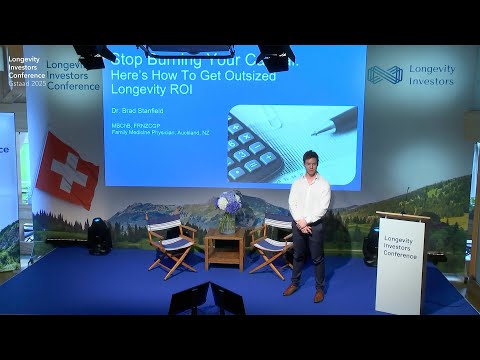
I have run this through Claude. 15 mins is a short video and I have watched a bit. I quite like Brad Stanfield even if I disagree with him on a number of things. He does try to operate on an ethical manner.
I’ll create a tidy transcript, summary, and critique of this talk on longevity investments.
TIDY TRANSCRIPT
Title: Stop Burning Your Capital - How to Get Outsized Longevity Return on Your Investment
Introduction
The speaker discusses four medication classes showing promise in longevity (two currently prescribed in clinic), skincare devices for reversing aging signs, and importantly, two major mistakes in the longevity field to avoid.
Part 1: Two Cautionary Tales
Resveratrol Failure
- Early 2000s: Heralded as longevity supplement
- Claimed to activate SIRT1/SIRT2 enzymes
- Based on single-cell research and mouse studies
- GSK purchased rights for $720 million
- After years of attempts and millions more spent, research could not be replicated
- Total loss of investment
Ovarian Stem Cell Failure (OvaScience)
- Promise: Using stem cells to treat infertility and extend fertility window
- Company founded in 2011 based on initial lab findings
- Could never replicate initial results
- Led to investor lawsuit and SEC fraud settlement
- Company eventually collapsed after mergers/acquisitions
Common Pattern:
- Exciting initial discovery (usually single lab)
- Massive investment flows in
- Years later: inability to replicate results
- Total loss and credibility damage to longevity field
Part 2: The Better Approach - Learning from SpaceX
SpaceX Falcon 9 Analogy:
- Goal: Reusable rockets (launch and land)
- Built from solid foundation based on testing
- Failures were expected and used for learning
- Iterative approach led to 2015 success
Key Lesson: Build from solid scientific foundation, then scale.
Part 3: The Interventions Testing Program (ITP)
What Makes ITP Special:
- Tests molecules in mice for health/lifespan extension
- Same experiment run simultaneously in three different labs
- Uses genetically diverse mice (better human translation)
- Built-in reproducibility
Why This Matters:
- Cancer research example: Amgen (2012) tried replicating 53 foundational cancer studies
- Only 6 of 53 were reproducible
- Explains disappointing cancer treatment progress
ITP Saved Capital - Two Examples:
-
Fisetin (Senolytic)
- Theory: Remove senescent cells to prevent tissue damage
- ITP result: No lifespan extension, no benefits
- Conclusion: Senolytic preclinical work not ready for scaling
-
Nicotinamide Riboside (NAD+ precursor)
- Theory: Support NAD metabolism central to cellular function
- ITP result: No lifespan extension, no benefits
- Human trials: Mixed results, nothing significant
- Conclusion: Pre-clinical NAD work insufficient
Part 4: Four Promising Medication Classes
1. SGLT2 Inhibitors (Currently prescribing)
- Mechanism: Kidneys excrete glucose
- Primary use: Type 2 diabetes
- Repurposed benefits:
- Heart failure: Reduced hospitalization and cardiovascular death (non-diabetic patients)
- Kidney disease: Less protein leakage, slower decline, reduced dialysis risk
- Pre-clinical evidence: May help with senescence and glucose spike management
- ITP result: Canagliflozin extended male mice lifespan by 14%
- Future potential: Low-dose use in healthy individuals
2. Rapamycin (Currently prescribing)
- “Golden child” of ITP
- Extends male and female mice lifespan 17-25%
- Challenges: Used clinically as immunosuppressant (transplant patients)
- Recent progress: Correct dosing shows no immunosuppressive effects or increased infections
- Speaker’s research: Clinical trial combining rapamycin with exercise in older adults
- Results submitted for peer review (available after talk)
3. GLP-1 Medications (Currently prescribing)
- Primary use: Type 2 diabetes
- Mechanism causes significant weight loss
- Repurposed for: Weight loss, sleep apnea, heart failure, kidney health
- Potential: Micro-dosing in healthy individuals for longevity
- Innovation pipeline:
- GLP-1 alone
- Tirzepatide (GLP-1 + GIP): Greater weight loss
- Retatrutide (triple combination): Even greater weight loss (Phase 2)
4. PCSK9 Inhibitors
- Mechanism: Lower LDL cholesterol by increasing liver LDL receptors
- Potential: Revolutionize cardiovascular disease prevention
- Innovation: Small interfering RNA (siRNA) versions
- Single dose reduces LDL by ~50% for 6 months
- Massively improves adherence
- Could dramatically reduce cardiovascular disease
Part 5: Skin Aging Reversal Devices
Traditional Approach:
- Ablative lasers: Burn top skin layer, stimulate repair
- Great results but significant recovery time
Modern Innovations:
- Non-ablative devices: Nearly as effective, minimal recovery
- LED/red light therapy
- IPL (Intense Pulsed Light): Treats freckles and age spots
- Speaker personally uses and recommends to patients
Conclusion: The New Investment Model
Old Model: Bet big on early results
New Model:
-
Validate initial results (reproducibility)
-
Iterate and learn
-
Scale from solid foundation
Benefits:
- Avoid hype traps
- Invest in validated interventions
- Protect capital
- Build credibility for longevity field
SUMMARY
This talk presents a framework for longevity investment decisions based on scientific rigor. The speaker warns against two major failures (resveratrol and OvaScience) that cost hundreds of millions due to irreproducible initial findings. The solution: the Interventions Testing Program (ITP), which tests interventions across three labs simultaneously using genetically diverse mice, ensuring reproducibility before human trials.
Four medication classes show promise: SGLT2 inhibitors (14% lifespan extension in mice, already prescribed for diabetes/heart/kidney disease); rapamycin (17-25% lifespan extension in mice, new dosing protocols avoid immunosuppression); GLP-1 medications (weight loss and metabolic benefits, newer combinations show greater effects); and PCSK9 inhibitors (particularly siRNA versions offering 6-month LDL reduction from single dose).
The core message: validate science through reproducible pre-clinical work before massive investment, avoiding the hype cycle that has damaged the field’s credibility.
CRITIQUE
Strengths:
-
Compelling framework: The SpaceX analogy effectively illustrates iterative, evidence-based development vs. premature scaling.
-
Concrete examples: The resveratrol and OvaScience failures provide sobering context, while the Amgen cancer replication crisis (6/53 studies) powerfully demonstrates systemic reproducibility problems.
-
ITP emphasis: Highlighting a rigorous, multi-site testing program is valuable and underutilized in longevity discourse.
-
Balanced approach: Acknowledging fisetin and NR failures prevents selective reporting and builds credibility.
-
Practical relevance: Speaker actively prescribes these medications, suggesting real-world clinical experience.
Weaknesses:
-
Mouse-to-human translation oversimplified: While ITP uses genetically diverse mice, the speaker doesn’t adequately address the fundamental limitations of mouse models. Mice aren’t simply “small humans” - they have different metabolic rates, lifespans, and disease mechanisms. The 14% canagliflozin extension in male mice (notably, not females) is presented optimistically without discussing why sex differences matter or what this might mean for humans.
-
Rapamycin data withholding: Teasing “really interesting” results while keeping them confidential undermines the talk’s transparency theme. If results are under peer review, basic findings could still be shared. This creates the same “exciting discovery” hype the talk warns against.
-
Off-label prescribing concerns: The speaker “routinely prescribes” these medications but doesn’t clarify whether this is on-label (diabetes, heart failure, kidney disease) or off-label (healthy individuals for longevity). If off-label, ethical considerations about prescribing medications with known side effects to healthy people deserve discussion.
-
GLP-1 uncritical presentation: GLP-1 medications have significant side effects (nausea, vomiting, potential pancreatitis, and concerning emerging data about muscle loss with rapid weight loss). “Micro-dosing in healthy individuals” is speculative and potentially dangerous without acknowledging these risks.
-
PCSK9 cost barrier ignored: These medications currently cost $5,000-14,000 annually. The siRNA versions will likely be expensive too. This is a massive barrier to the “revolutionary” cardiovascular disease prevention claimed.
-
Skin devices tangential: The skincare segment feels disconnected from the medication focus and lacks the same evidence standard. “Non-ablative devices offer almost as good results” - compared to what studies? This section undermines the evidence-based message.
-
Financial conflicts unaddressed: As someone prescribing these medications and involved in rapamycin trials, the speaker likely has financial interests (speaking fees, research grants, potentially consulting). These should be disclosed.
-
Selective ITP interpretation: The speaker uses negative ITP results (fisetin, NR) to dismiss those interventions but positive results (canagliflozin) to enthusiastically endorse SGLT2 inhibitors. However, one 14% male-only extension might be a fluke - where’s the ITP replication data for canagliflozin? The same skepticism applied to fisetin should apply here.
-
Missing nuance on existing uses: SGLT2 inhibitors and GLP-1s are already prescribed for their approved indications. Framing these as “longevity interventions” when they’re treating diseases (diabetes, heart failure, obesity) conflates disease treatment with lifespan extension in healthy people - a critical distinction.
-
Validation paradox: The talk advocates validating through ITP before human trials, yet three of four medication classes highlighted are already in human use for other conditions. This isn’t following the proposed framework - it’s repurposing existing drugs, which is a different strategy entirely.
Bottom Line:
This is an engaging talk with important messages about reproducibility, but it doesn’t fully practice what it preaches. The speaker advocates skepticism and solid evidence yet promotes interventions (particularly rapamycin and “micro-dosing” GLP-1 in healthy people) that haven’t completed the validation process they champion. The framework is sound, but the application is inconsistent. A stronger version would include confidence intervals, effect sizes, side effect profiles, cost analyses, and disclosed conflicts of interest.