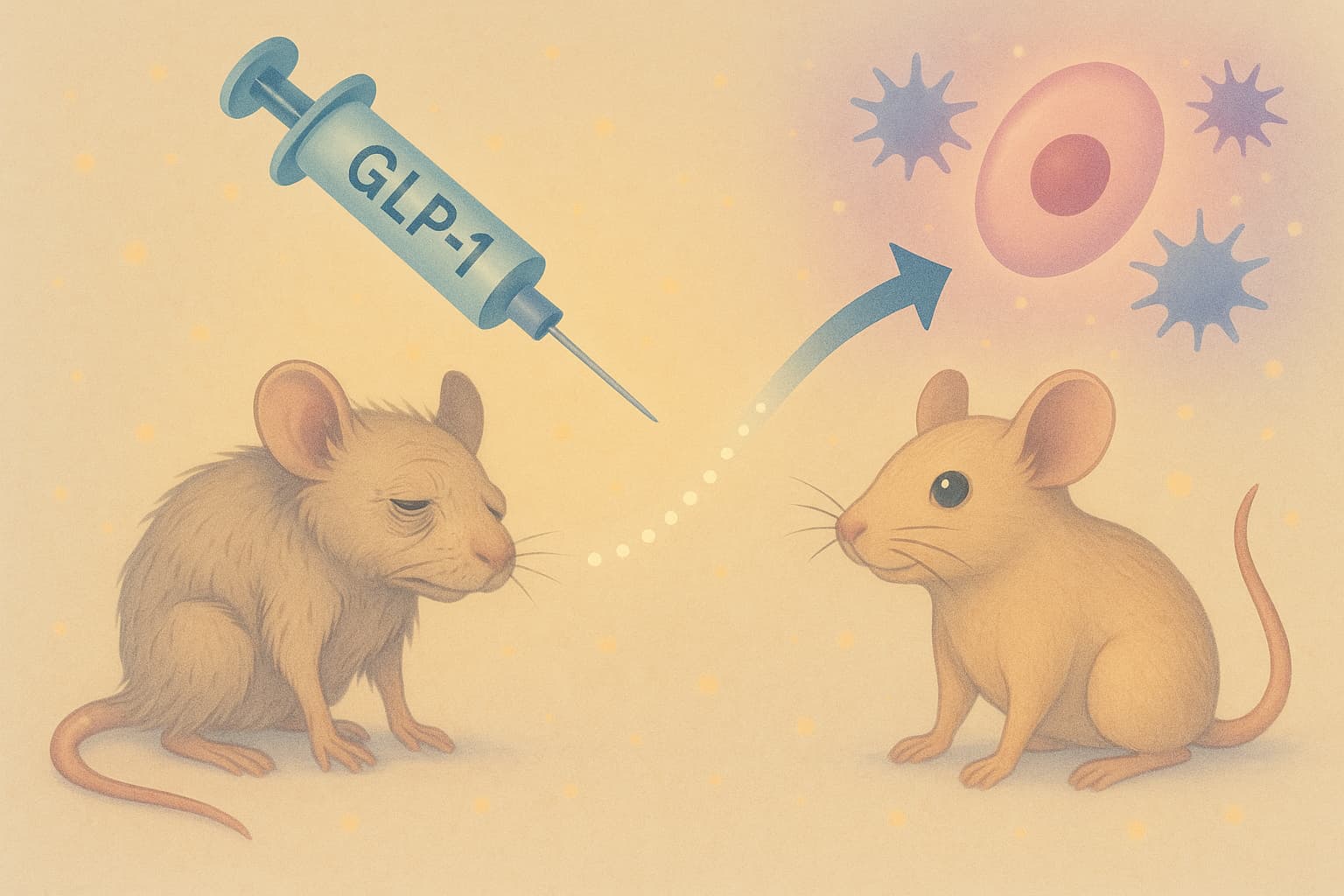
A new Cell Metabolism study reports that GLP-1 receptor agonists—currently known for weight-loss and metabolic control—produce broad, body-wide anti-aging effects in mice independent of weight loss. The work arrives just as the more effective new oral GLP-1 pills are slated for release next year, significantly expanding the practical reach of this drug class and elevating their relevance to the longevity community.

In the study, middle-aged and older male mice received long-term GLP-1RA treatment at doses too low to alter appetite or body weight. This design was deliberate: the goal was to isolate the drug’s intrinsic aging biology effects. After several weeks, researchers conducted deep multi-omic profiling across major organs. The results were unambiguous—tissues ranging from the liver and muscle to the colon, adipose depots, blood, and even regions of the brain shifted toward a younger molecular state. Gene-expression programs normalized, chronic inflammation signatures diminished, metabolic pathways rebalanced, and epigenetic patterns moved in a youth-associated direction. Functional testing echoed these findings: treated older mice exhibited stronger grip and superior motor coordination.

One of the most consequential observations was the overlap between GLP-1–induced rejuvenation patterns and those produced by rapamycin, the canonical mTORC1 inhibitor that has extended lifespan in every mammalian study completed to date. mTORC1 acts as a nutrient-sensing growth switch; when chronically activated, it suppresses autophagy, accelerates protein damage, distorts cellular metabolism, and drives hallmark aging pathology. Rapamycin works by inhibiting this overactive pathway.

GLP-1R agonists engage aging biology differently. Rather than acting directly on nutrient sensing, they recalibrate metabolic and endocrine communication through the hypothalamus, producing downstream effects—enhanced proteostasis, reduced inflammation, metabolic normalization—that converge with the benefits of mTOR inhibition. In practical terms: GLP-1s may achieve a portion of rapamycin’s biological “reset,” but through a neuroendocrine route that could carry fewer immunosuppressive consequences.

For longevity-focused individuals, several actionable insights emerge:

1. GLP-1s may have geroprotective value even at doses below those used for weight loss.

Future human trials may explore “metabolically quiet” doses that avoid appetite suppression while targeting systemic aging pathways.

2. Combining GLP-1s with lifestyle interventions likely produces synergistic benefits.

The molecular changes observed align with improved metabolic flexibility—an effect amplified by resistance training, fasting-mimicking diets, and reduced ultra-processed food intake.

3. With new oral GLP-1 pills arriving soon, adherence, affordability, and long-term deployment will improve dramatically, making them viable candidates in structured, physician-supervised longevity protocols.

4. GLP-1s may serve as an option for individuals unable to tolerate rapamycin due to side-effects, or for those seeking partial mTOR-like benefits without immunosuppression.

Still, major limitations remain. The study used only male mice, leaving female biology unexplored. Cognitive improvements were limited, underscoring that brain aging may require additional modalities (exercise, sleep optimization, neurotrophic support, rapamycin, or senolytics). Most importantly, lifespan extension was not measured—so rejuvenation signatures, while encouraging, require validation in long-term survival and disease-onset studies. And chronic GLP-1 use in healthy humans remains insufficiently studied.

Even with these caveats, the findings suggest a paradigm shift: GLP-1 medications—soon available as both injections and moderately expensive pills—may represent one of the first widely accessible pharmacological tools capable of modulating core mechanisms of aging.

Source Research Paper (Open access): Body-wide multi-omic counteraction of aging with GLP-1R agonism

CGPT In-depth analysis of paper: https://chatgpt.com/share/6929ef82-baa8-8008-93f1-04d27c98a9e5

Disclaimer: All these posts are generated with the help of AI systems, and there could be mistakes. Validate with good medical sources before taking any course of action.

10 Likes

This doesn’t surprise me at all. After a month of retatrutide at a low dose of 1 mg per week, I lost weight, yes, but I also feel a subjective improvement in my sense of well-being. When I have a blood panel done in the next few weeks, I expect that this subjective sense will be reflected in the numbers.

5 Likes

I’m surprised you managed to lose anything on that low of a dose. Been doing much higher doses of Reta and/or Tirze and have lost about 25Lbs, but I’m finding it real hard to lose the last 10lbs (to reach my goal) even after trying Reta at 7mg, and then Tirze at 10mg. I do however (like you) feel healthier overall apart from couple side effects at higher doses.

2 Likes

Key passage. Rapamycin has had many lifespan studies, including ITP. Biomarkers are fine, but we need some reassurance about long term effects, and of course lifespan. So GLP-RA ITP awaiting. Also, “oral GLP-1 agonists are coming”, umm no need to wait, Rybelsus is already on the market.

Of course, we need human studies long term, but then again that’s true of rapamycin too, yet here we are gobbling it up hoping for the best (some of us).

3 Likes

I’m surprised myself. I guess I’d be classified as a strong responder. No side effects either.

Good luck to you.

2 Likes

Triple-Hormone-Receptor Agonist Retatrutide for Obesity - A Phase 2 Trial - PubMed.

7.2% body weight loss in the 1mg group after 24 weeks

5 Likes

Reta is not FDA approved yet. I’d recommend caution — these drugs (GLP-1 RA) can cause metabolic acidosis in some people and cases, especially when stacked and/or after all the fat is lost.

1 Like

These kinds of drugs are the next step: Triple IGF-1/GLP-1/GIP Incretin Receptor Agonist;

https://diabetesjournals.org/diabetes/article/73/Supplement_1/2059-LB/155764/2059-LB-NA-931-a-Novel-Triple-IGF-1-GLP-1-GIP

3 Likes

It’s more and more likely this drug, called Bioglutide, doesn’t actually exist. Please see The Bioglutide Scam: Lies and Fraud at Biomed Industries - Aus Aminos Blog

6 Likes

Gokhan, do you have a reference for this claim? A lit search (with help of OpenEvidence) said there’s no evidence for this. Are you thinking of SGLT2 inhibitors?

Thanks for sharing, wasn’t aware of this! What do you think about this news;

Could China’s New GLP-1 Drugs Beat Out Ozempic? (Scientific American)
GLP-1 drugs currently being tested in China target complications associated with obesity such as heart disease, fatty liver disease and type 2 diabetes

1 Like

Haven’t heard much about ecno, but more about mazdutide, which has already completed phase 3,and set to go into market next year.

1 Like

A single Google Search for “tirzepatide metabolic acidosis” gives me many case reports:

https://www.sciencedirect.com/science/article/abs/pii/S2352007825002756

https://amjcaserep.com/abstract/full/idArt/946133
https://journals.lww.com/jasn/fulltext/2025/10001/tirzepatide__failing_the_acid_test__th_po0427.669.aspx

Co-administration with SGLT2 in a diabetic patient:

I personally experienced it after ~3 yrs of GLP1-RA (1 yr tirzepatide 10mg, 2 yrs Retatrutide 8mg, not simultaneously). I think Reta is the main reason. There are no symptoms for me. Just blood CO2 measurement coming consistently below normal. While Lactate is all normal. I think this is beta hydroxybutyrate. Stopping Reta seemed to have resolved it. Now I’m adding back Tirz to see if Tirz itself causes it or not. Doing Keto diet makes it worse (though it was happening without any keto).

PS: The AI tool you mention sounds clueless. I would re-consider using it. Just plain google search is great (+ all the deep research tools). Alternatively I started using Google Scholar labs – also great. https://scholar.google.com/scholar_labs/search?hl=en)

2 Likes

I haven’t been able to get access to Open Evidence, but I suspect it’s the best out there for medical questions. It’s the best-funded startup in this niche I think. They have partnerships with all the leading medical publishers so they have full and immediate access to all the research papers that come out… which means their AI system should have better information than any other system out there, from my calculations…

OpenEvidence, an AI platform for doctors, has secured significant funding in 2025, including a $210 million Series B round (July) and a $200 million Series C round (October), bringing its total funding to nearly $500 million and its valuation to around $6 billion. Major investors include Google Ventures (leading both rounds), Sequoia,Kleiner Perkins, Blackstone, Thrive Capital, and Coatue, with funds used to develop medical AI for clinical decision support and research.

1 Like

Thanks for the info. Google Scholar labs is great if they give you access (I’ve been using it for anything serious, though you might only get 5 queries / day even while being a paid gemini user). I might have tried getting OpenEvidence, though don’t remember being able to run queries.

Seems odd that you wouldn’t have any symptoms. Interestingly, OpenEvidence misses the boat when I use the term “incretin mimetics” to ask about euglycemic ketoacidosis, but gets it right when I use “tirzepatide” specifically. It appears to be a very rare phenomenon and much less common than with patients on SGLT2 inhibitors. Avoiding dehydration and severe caloric restriction while taking a GLP medication is critically important in any case.

How do you make the case for it being potentially more common in lean individuals? I’d think an obese person losing weight fast (flood of free fatty acids hitting the liver) along with decreased carb/protein intake (reduced insulin secretion) and insulin resistance would be the key driving factors. Those who are already lean are typically insulin sensitive and don’t have the large fat stores being broken down. They’re also (hopefully) eating calories to maintain weight (and/or to gain muscle).

Retatrutide melts away your visceral fat. Tirzepatide is only ~50% as effective at that. As the visceral fat stores are eliminated, and fasting glucose is kept very low (via these drugs), I suspect your body feels the need to tap into something else… and that turns out to be ketones. And ketones create anywhere from mild to severe metabolic acidosis. This is pure speculation on my part but seems to be consistent with what I’ve read so far. (Retatrutide melting away liver fat: Triple hormone receptor agonist retatrutide for metabolic dysfunction-associated steatotic liver disease: a randomized phase 2a trial | Nature Medicine)

2 Likes

Mild ketosis is likely quite beneficial in some regards and may in actually be a bonus health benefit of reta and SGLT2i meds. Ketoacidosis is a different story altogether. Anecdotally, I’m on multiple peptide forums where hundreds of people have been taking retatrutide for a year or more, and I’ve never heard of any reports of ketoacidosis, euglycemic or otherwise. I’m sure there will be case reports in the literature since reta is more ketogenic due to its glucagon agonism, but it’s just not something the experts are talking about as a major potential safety issue.

In one sense it might be less likely to happen on reta because for most people it’s not nearly as potent of an appetite suppressant compared as tirzepatide, and the best defense against euglycemic ketoacidosis is to maintain food and fluid intake. As long as there’s even a small amount of insulin secretion and there’s adequate hydration, euglycemic ketoacidosis is going to be extremely rare and unlikely.

1 Like

Not my experience. Mine only moved from around 104 to about 96-97 on either Tirze 10 or Reta 6-8. It was the addition of SGLT2 and Acarbose that reduced it into low to mid 80.

1 Like

There are many response variations by individual with GLP1’s.

Weight loss is dose dependent, consider increasing your dose, that’s what works in all the weight loss trials.

GLP1 effects on weight are dose dependent.pdf (48.7 KB)

4 Likes