1 month on SS 31 - next time I’m feeling flush I’ll splurge on this one again.

Ongoing with ARA 290, will go for 3 months and see,

My litmus test will be our daughter who had a sever allergic reaction to Cipro is what they call “floxed” one of her symptom for the past 8 years is neuropathy from the knees down that ebbs and flows but the pins and needles are there all the time.

She is 2 weeks in now and no result, it seems like it takes 28+ days for any result.

1 Like

I’ve tried that one but not enough benefit for me to continue. It did have a positive effect on my workouts as well.

I take a lot of peptides and I’m always willing to go back for another go :-I

I’ve been making a skin care product with GHK-cu for about 3 years. Mostly for friends and family, works well.

Four months ago I was getting a dry spot on the right side of my forehead and even my blue magic was not fixing it.

I started the GLOW protocol 4 weeks ago, which is a BPC+TB500+GHK-cu combo that is popular with the influencers. I’ve been taking BPC+TB for over 2 years now and it’s been great with fast recovery, healed all my old war wounds, etc. But was not doing anything for the dry spot.

After 2 weeks of GLOW I was thinking it was helping. Now a month in and the dry spot is gone. I’m sold on GLOW :slight_smile:

The commonly sold version is 10-10-50 10mg BPC + 10mg TB + 50mg GHK
My combo is 15+15+60

If I was only a casual user the 10-10-50 might be acceptable but the 10-10 dose is lower than I currently use daily. So I jacked it up,
Every morning I get 500mcg + 500mcg + 2.0mg

If I was to use the “standard” GLOW every day I would only get
335mcg + 335mcg + 1.67mg

People often experience “sting” from GHK-cu and dilute it quite a bit. Since I only use iPEN cartridges now and they are limited to 3mL BAC water vs typical vials that hold 5mL My dilution rate is quite a bit lower. So to prevent sting I use 1mL PBS and 2ml BAC water and it works a treat :slight_smile:

I’ve also switched my “type” of TB500 from the frag 1-4 to the full Thymosin β4 43aa, while it is a bit more expensive I’ve been doing a lot of research with Perplexity on various peptides and this change makes sense to me.

2 Likes

An intrepid self-researcher on another forum discovered that diluting GHK-Cu with even a small amount of GHK-basic completely gets rid of the sting and the injection site reaction, for those who have access to GHK-basic. The theory is that free copper in the GHK-Cu is responsible for the reaction and that the small amount of GHK-basic binds it up.

3 Likes

Me too. I’ve got a freezer full of this and that! Lol

1 Like

Hi Steve, where are you buying your peptides? I just finished a round of tb4 from my doc but it was expensive. Looking to try bp157 next and would like to find a reliable online source. They have both helped in healing an injury I had in the past. Thanks in advance.

1 Like

I was recommended TB4 to help with recovery s/p arthroscopic knee surgery with some cartilage damage. Unfortunately, I can’t find the basis for this recommendation. Studies on arthritis and TB4 show that it is elevated and proportionate to the degree of OA both in the joint and in serum. Elevated TB4 seems to be a marker for OA severity. Also, MOA doesn’t make sense in regards to OA. It activates MMPs which breakdown cartilage, so again I see no possible benefit for my case and potential worsening. You can argue it is elevated as a body healing response to cartilage damage, but if that’s true the body is already overproducing it and I shouldn’t need to supplement. More likely, it seems to be detrimental to joint health from what I can find. Thoughts or experiences from anyone?

I cannot wait to try this!
Results and conclusion: The effective dose of GB-115 was determined at 6 mg per day. Drug action is characterized by fast onset of anxiolytic effect with stimulating properties and beneficial effect on sleep disturbances and autonomic symptoms. GB-115 treatment was associated with favorable changes in attention parameters, reaction time and overall performance. In contrast to first-line drugs for GAD treatment (SSRIs and SNRIs), GB-115 does not induce initial overactivation, anxiety and sleep disturbances. GB-115 is safe and has a good tolerability.

2 Likes

After two months of this, two sprays a day, I’m impressed. It’s made me a lot less shy.

4 Likes

GPT5 summary of full study:
Study Title:
Results of a Clinical Study of a New Anxiolytic, a Blocker of Central Cholecystokinin Receptors (GB-115)
Published in: S.S. Korsakov Journal of Neurology and Psychiatry, 2019, vol. 119, no. 8, pp. 53–60.
Authors: Neznamov G.G., Dorofeeva O.A., Metlina M.V., Syunyakov T.S., Minaev S.V., Ivashkina N.Yu., Martyanov V.A., Seredenin S.B.


Objective

To evaluate the anxiolytic (anti-anxiety) action, safety, and tolerability of GB-115, a low-affinity central cholecystokinin (CCK) receptor blocker, in patients with generalized anxiety disorder (GAD).


Background

  • CCK plays a regulatory role in anxiety and interacts with neurotransmitters like GABA, dopamine, and endogenous opioids.
  • GB-115 (amide N-(6-phenylhexanoyl)-glycyl-L-tryptophan) is a novel peptide compound synthesized at the Zakusov Institute.
  • Preclinical studies showed anxiolytic effects without sedation, muscle relaxation, or dependence potential—unlike benzodiazepines.
  • GB-115 also showed no mutagenic, embryotoxic, or allergenic properties.

Methods

  • Design: Open-label pilot Phase IIa clinical study.
  • Sample: 31 patients (22 women, 9 men), aged 22–53 years, diagnosed with GAD (ICD-10 F41.1).
  • Duration: 21 days.
  • Dosing: Sequential escalation from 3 mg to 12 mg daily to determine an effective dose.
  • Final effective dose: 6 mg/day.
  • Assessments:
    • Hamilton Anxiety Rating Scale (HAM-A)
    • Spilberger–Khanin State Anxiety Test
    • Multidimensional Fatigue Inventory (MFI)
    • Clinical Global Impression (CGI)
    • NS-Psychotest (computerized cognitive testing)
    • Symptom severity and sleep quality evaluations.

Results

1. Dose finding

  • 3 mg/day: mild effects; insufficient efficacy.
  • 6 mg/day: strong and consistent therapeutic effect.

2. Efficacy

  • Anxiolytic effect: Anxiety scores on HAM-A decreased from 22.2 to 6.3 by day 21 (p<0.01).
  • Fatigue reduction: MFI decreased from 64.3 to 36.0 (p<0.01).
  • Sleep improvement: Reduction in insomnia and nocturnal awakenings.
  • Cognitive and psychomotor enhancement: Faster reaction times, improved attention and operator performance (via NS-Psychotest).
  • Clinical Global Impression (CGI):
    • By day 21, 92% of patients experienced significant or very significant improvement.
    • Effect onset occurred rapidly, within 3–7 days.

3. Safety and tolerability

  • Excellent overall tolerability.
  • Adverse events in 4 of 31 patients (12.9%), all mild and transient: mild hypertension, dry mouth, hypercholesterolemia, menstrual irregularity.
  • No sedation, motor impairment, or withdrawal phenomena observed.

Key Findings

  • Therapeutically effective dose: 6 mg/day.
  • Distinct pharmacological profile:
    • Rapid anxiolytic onset.
    • Mild stimulating effect improving daytime alertness.
    • No sedation or dependence.
    • Normalization of sleep and autonomic symptoms.
  • Mechanistic implication: Supports the role of the cholecystokinin system in anxiety regulation.
  • Comparison to SSRIs/SNRIs: GB-115 lacks the early-phase overstimulation and anxiety exacerbation typical of antidepressants.

Conclusion

GB-115 is a novel, fast-acting anxiolytic that combines anti-anxiety and mild activating properties without sedation or dependence risk. It demonstrated high tolerability and safety, suggesting potential as a next-generation treatment for generalized anxiety disorder and anxiety-asthenic syndromes. Further controlled trials are recommended to confirm its efficacy and register it as a therapeutic agent.


Citation:
Neznamov G.G., Dorofeeva O.A., Metlina M.V., Syunyakov T.S., Minaev S.V., Ivashkina N.Yu., Martyanov V.A., Seredenin S.B. Results of a clinical study of a new anxiolytic, a blocker of central cholecystokinin receptors. Zhurnal Nevrologii i Psikhiatrii im. S.S. Korsakova. 2019;119(8):53–60.

1 Like

Just arrived. Will try to keep updated on effects.

2 Likes

First day: Slight acute reduction in anxiety and a modest increase in general feeling of wellbeing. No interruption of sleep. Sleep was quite good actually, but I didn’t feel sedated.

1 Like

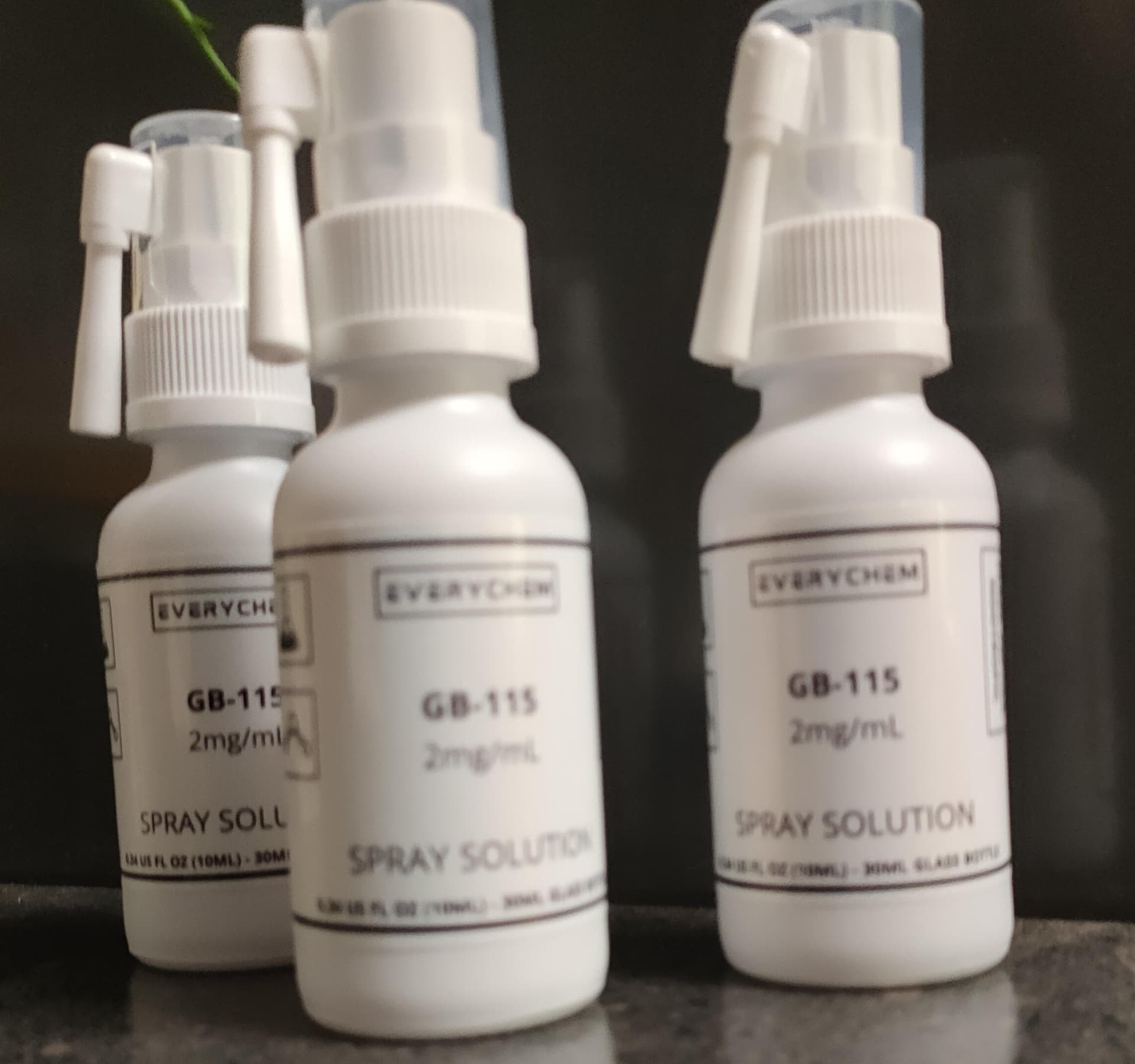
GB-115 is a nasal spray? What is the cost? Where can you buy it?

2 Likes

https://everychem.com/product/gb-115-spray-solution-2mg-ml/

It also comes as a tablet but apparently it is more bioavailable in nasal spray.

This is the tablet but I’ve never used it, or purchased from this website: Ranquilon 1 mg 60 pcs - Buy online

Hi Steve, my nasal Oxytocin stopped working after 4-5 months…
Why do you do nasal rather than inject? Also does the KLOW cause insomnia and why do some people cycle? It looks like you do it daily?

I have switched from the TB500 (frag 1-4), proper name Goralatide, to the full version of TB500 which is Thymosin Beta 4, the full 43 amino structure of the naturally produced Tb-4

It is sometimes referred to as TB500 (aa43) on the net.

It offers the full range of benefits and while it does cost twice as much at wholesale we are providing it at the same price as the other 2 “versions” of TB500 - (frag 1-4) and (frag 14 - 21),

I don’t see any reason to use the FRAGMENT versions of this peptide.

I’ve done a deep dive with Perplexity and after reading the info that provided, I’m pretty comfortable with this change and increased benefits.

1 Like

Oxytocin could be injected, the nasal spray seems to be the standard way to use low dose OT. The thing with some peptides is that after months of use, it becomes one’s new normal. It is probably still doing the job, but being happy and less stressed is now my new normal so it it really working?

Kind of like when schizophrenic’s feel better and stop their meds. They thought they were all better and didn’t need the meds anymore because they became “normal”. I’ve seen this in more than 1 person.

I have no experience with KLOW (KPV + TB500 + BPC 157) so no idea on why there are reports of insomnia. If I was to guess it would be the KPV peptide because the GKH-cu in GLOW doesn’t do that.

Lots of experience with GLOW (GHK-cu + TB + BPC)

I am getting some KPV in though

Many people cycle on and off various peptides due to the potential for desensitization. The problem I see with that, this idea is primarily “cautionary” with no clinical evidence in humans that I can find. How did this idea come to saturate the influencers and internet? This cautionary approach comes from the methodology used in clinical trials and has carried over to non-trial use.

Many aspects of early clinical trials are managed with an eye to extreme safety. Once a compound passes clinical trials much more data is available to sort out factors like safe dosing, dose cycles, etc.

Chronic use is one of those cycling factors and it’s not always related to “desensitization” as many compounds, when used chronically, can have side effects so they are used acutely.

In some instances I can be cautious, but with peptides and their typically short half lives I don’t feel that it’s necessary. Consider that our body makes 7,000 different peptides, peptides are life. If the peptide being used is bio-identical to the one produced in our body I personally don’t see desensitization as a real issue. The real issue is that my body as it ages produces less of the good stuff and seemingly more of the bad stuff, so I “supplement” the good stuff to combat the bad stuff.

Consider that there is now significantly more types and much longer lasting GLP1’s used in tens of millions of people over the past 14 years with no sign of “desensitization” with this highly modified peptide. I have asked Perplexity why would our body become desensitized to the peptides our body makes?

I’ve used Perplexity to try and understand this aspect and it comes back with the “safety” factor almost every time and how it’s related to the way clinical trials are run. Then it references “influencer” opinions on this which are not based in the actual science, just their opinion. Which seems to be itself influenced by clinical trial methods of safety.

I have yet to see enough or any real clinical data in humans with the top 15 commonly used peptides to indicate this is a real problem.

With the hGH stimulating combo I have been using 5 nights a week for over 2 years, I get a reaction every time I use it. Last night, the exact same reaction I got when I started. If that reaction ever went away I would suspect desensitization or a weak peptide. But that has not happened.

If anyone can find actual human study data on desensitization of bio-identical peptides, I’d love to read it.

1 Like

Hi how’s it going I’m new on this site and slowly learning the ropes here a bit I’m curious about the BP 115 and the other peptides I think they are that have some are effects do you know any reputable places that they could be purchased? Cheers! Thx! :+1:

I use Perplexity Enterprise Pro. It accesses 4 of the top AI’s

As I get better with my AI prompts and have learned that any search by AI will get polluted with internet influencer blather, I do 2 or 3 searches, one for a quick overview with few restrictions on where to search. Then I hone in on some specific I’m looking for and then redo the search this way to reduce the noise factor

I asked Perplexity for “clinical trials published in reputable journals with any evidence in humans of desensitization to exogenous use of peptides”

It started thinking at about 12:30 yesterday, when I left at 3:30 it was still “thinking” and had not produced any results.

“normal” results take about 1 minutes, more focused results take 5 to 10 minutes.

BPC 157 is a good one, especially when in a combination with TB500 (aa43)

Add GHK-cu to that combo and you have a great healing combo that also helps with skin.

1 Like