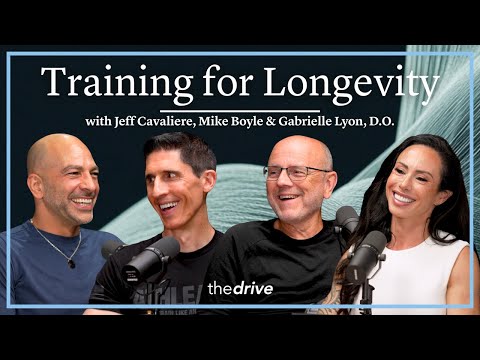
Training for longevity: A roundtable on building strength, preventing injury, protein, & more
AI Summary:
Resistance Training, Longevity, and Muscle-Centric Medicine: Roundtable Analysis
A. Executive Summary
This roundtable discussion, hosted by Peter Attia, features three distinct experts in human performance: Dr. Gabrielle Lyon (Geriatrics and Nutritional Sciences), Mike Boyle (Strength and Conditioning Coach), and Jeff Cavaliere (Physical Therapist and founder of Athlean-X). The core thesis is that skeletal muscle is the organ of longevity, yet the majority of the population fails to engage in the resistance training necessary to maintain it. The conversation dismantles the traditional “powerlifting” dogma (squat, bench, deadlift) as the only path to strength, arguing instead for risk-managed, longevity-focused training protocols that prioritize consistency over intensity.
A significant portion of the dialogue focuses on the risk-reward trade-off of heavy spinal loading as one ages. Both Boyle and Attia argue that bilateral back squats and heavy deadlifts become orthopedically expensive for the aging individual, advocating for unilateral (single-leg) training which bypasses the “bilateral deficit” and reduces spinal compression. Dr. Lyon provides the metabolic context, defining muscle not just as a contractile tissue but as a metabolic sink for glucose and a predictor of survivability against chronic disease.
The group also addresses the crisis of youth sports specialization, agreeing that early hyper-focus on single sports leads to increased injury rates and burnout. Conversely, they argue for “sampling” (playing multiple sports) to build general athleticism. Finally, the discussion pivots to practical longevity strategies: prioritizing protein intake (minimum 100g/day), eliminating biomechanically compromised exercises (the “Iron Graveyard”), and training proprioception (balance) to prevent falls—the leading cause of catastrophic decline in the elderly.
B. Bullet Summary
-
Muscle as the Organ of Longevity: Skeletal muscle is the primary site for glucose disposal and metabolic regulation; its degradation (sarcopenia) is a primary driver of aging and chronic disease.
-
The Bilateral Deficit: Individuals often possess greater cumulative strength on single legs (left + right) than on both legs simultaneously due to neurological inhibition during bilateral lifts.
-
Unilateral Superiority: Single-leg training (e.g., Bulgarian split squats) stimulates high-threshold motor units and hypertrophy without the compressive spinal load of heavy back squats.
-
The “Iron Graveyard”: Certain exercises have a poor risk-to-reward ratio and should be abandoned, specifically upright rows (shoulder impingement risk) and unsupported chest flys (anterior capsule stress).
-
Nutrition Drives Composition: Leanness is achieved primarily through caloric control and nutrition, while training provides the stimulus for muscle growth; you cannot “out-train” a diet deficient in protein or excessive in calories.
-
Anabolic Resistance: As humans age, the efficiency of protein utilization drops. Older adults require higher protein intakes (specifically Leucine) to trigger muscle protein synthesis compared to adolescents.
-
Minimum Protein Threshold: A baseline of 100g of high-quality protein daily is recommended for all adults, regardless of sex, to support tissue turnover and muscle maintenance.
-
Youth Specialization Fallacy: Early sports specialization (pre-puberty) correlates with higher injury rates and lower long-term athletic success compared to a “sampling” period of multiple sports.
-
Proprioception Decay: Balance and reaction time degrade with age. Training balance with eyes closed is essential to prevent falls, as most falls occur in low-light conditions where visual feedback is absent.
-
Achilles Tendon Vulnerability: The Achilles is a common failure point in aging athletes; prevention requires soleus-specific stretching/rolling and ankle mobility work.
-
Consistency over Intensity: For the general population, the barrier to entry is often psychological (“it must be hard”). Consistency (attendance) yields better long-term results than sporadic high-intensity efforts.
-
Intermuscular Adipose Tissue (IMAT): IMAT (fat infiltration within the muscle) is likely a more accurate predictor of metabolic dysfunction and insulin resistance than BMI or total body fat percentage.
D. Claims & Evidence Table
| Claim Made |
Evidence Provided |
Assessment |
| Bilateral Back Squats are unnecessary for hypertrophy/strength. |
Boyle cites athlete data showing split-squat loads equal to front squat loads; Attia cites personal injury history and “bilateral deficit” neurology. |
Strong. Supported by biomechanical research on bilateral deficit and electromyography (EMG) studies on unilateral training. |
| Protein intake must be at least 100g/day. |
Dr. Lyon cites turnover rates of visceral tissue and the requirement of essential amino acids (specifically Leucine) to trigger mTOR in aging muscle. |
Strong. Aligns with current protein research suggesting 1.2–1.6g/kg for preventing sarcopenia. |
| Upright Rows cause shoulder impingement. |
Cavaliere cites biomechanics: internal rotation combined with elevation compresses the supraspinatus tendon against the acromion. |
Strong. Widely accepted in physical therapy and orthopedics; known mechanism for subacromial impingement. |
| Early sports specialization leads to higher injury rates. |
Boyle cites observations of overuse injuries in youth and “early succeeder” phenomenon; Lyon notes lack of injury reduction despite “advancements.” |
Strong. Supported by data from the American Medical Society for Sports Medicine and pediatric orthopedics. |
| Eating after 6 PM causes fat gain. |
Cavaliere refutes this, stating total caloric intake and protein consistency determine body composition, not meal timing. |
Strong. Thermodynamics and metabolic ward studies confirm total energy balance trumps meal timing for weight loss. |
| IMAT is a better predictor of disease than Body Fat %. |
Dr. Lyon cites clinical experience and emerging literature linking muscle fat infiltration to insulin resistance (e.g., PCOS). |
Speculative/Emerging. Strong theoretical basis, but DEXA/BMI remain the clinical standard due to cost/access of MRI/CT needed to measure IMAT. |
E. Actionable Insights
-
Switch to Unilateral Lower Body Training: Replace heavy spinal loading (back squats) with rear-foot elevated split squats (Bulgarian split squats) or reverse lunges. This maintains leg strength while sparing the lumbar spine.
-
Audit Your “Iron Graveyard”: Immediately stop doing Upright Rows and unsupported Dumbbell Chest Flys. Replace them with High Pulls (external rotation focus) and Floor Flys (to limit range of motion and protect the shoulder capsule).
-
Protein “Bookending”: Aim for a minimum of 30-50g of protein at the first and last meal of the day to ensure you hit the >100g daily floor. Focus on leucine-rich sources (animal products or fortified plant sources).
-
The “Eyes Closed” Balance Drill: Practice standing on one leg with eyes closed to train proprioceptive systems independent of vision. This mitigates fall risk as reaction times slow with age.
-
Soleus Care for Achilles Health: Perform aggressive foam rolling on the calf and specific soleus stretching (knee bent) to reduce tension on the Achilles tendon, especially if engaging in dynamic sports (pickleball, tennis).
-
Use the “Standing Cable Press”: If you have shoulder pain or labral issues, utilize the standing cable press. It allows for a functional pressing pattern without the fixed-path impingement of machines or bench pressing.
-
Gamify Fitness for Kids: Do not impose structured “sets and reps” on pre-pubescent children. Use games (e.g., card games dictating movements) to build motor patterns without the psychological burden of “training.”
-
Widen Your Lunge Stance: When performing lunges, step out slightly to the side (not walking a tightrope) and rotate the torso slightly over the front leg to lock the hip into a stable position.
-
Hydration and Fiber Audit: Following Boyle’s advice post-surgery, assess fiber intake and hydration status. Digestive health is often the silent point of failure in the 50+ demographic.
H. Technical Deep-Dive
1. The Bilateral Deficit and Neural Drive
The “Bilateral Deficit” (BLD) refers to the phenomenon where the maximal force produced by two limbs acting simultaneously is less than the sum of the forces produced by each limb acting individually ($F_{bilateral} < F_{left} + F_{right}$).
-
Mechanism: The primary driver is neurological inhibition. During bilateral exertion, the central nervous system (CNS) reduces neural drive to the motor units to maintain stability and protect the spine. Unilateral training bypasses this inhibition, allowing for higher motor unit recruitment in the target muscle group without the systemic fatigue or spinal shear forces associated with maximal bilateral loading.
-
Application: For longevity, this allows an individual to overload the quadriceps or glutes with high intensity while subjecting the lumbar vertebrae to significantly lower compressive forces.
2. Anabolic Resistance and Leucine Thresholds
Dr. Lyon references “Anabolic Resistance,” the age-related reduction in the skeletal muscle’s sensitivity to dietary amino acids and insulin.
-
mTORC1 Pathway: Muscle Protein Synthesis (MPS) is regulated by the mechanistic target of rapamycin complex 1 (mTORC1). In youth, insulin and low doses of amino acids easily trigger this pathway.
-
Aging Physiology: As tissues age, the “leucine threshold” required to trigger mTORC1 increases. While a child might trigger growth with 5g of protein, an older adult may require 2.5g to 3g of Leucine (approx. 30g of high-quality animal protein) in a single bolus to initiate the same anabolic response. This validates the recommendation for fewer, larger protein feedings rather than “grazing” on sub-threshold amounts.
3. Intermuscular Adipose Tissue (IMAT)
Distinct from subcutaneous fat (under skin) and visceral fat (around organs), IMAT is the infiltration of adipocytes between muscle fibers.
-
Pathology: High IMAT levels correlate strongly with insulin resistance. When fat infiltrates muscle tissue, it disrupts the insulin signaling cascade (PI3K/Akt pathway), preventing efficient glucose uptake (GLUT4 translocation). This renders the muscle—the body’s largest glucose disposal agent—metabolically inflexible, contributing to Type 2 Diabetes independent of total body mass.
I. Fact-Check Important Claims
Claim: 50% of Americans are not training or doing any kind of exercise.
-
Verification: True. According to CDC data (National Health Interview Survey), only ~24-28% of U.S. adults meet the combined aerobic and muscle-strengthening guidelines. Approximately 46-50% fail to meet either guideline significantly.
Claim: Kids who specialize early have higher injury rates.
-
Verification: True. A study published in the American Journal of Sports Medicine (2015) found that young athletes who specialized in a single sport were 81% more likely to experience overuse injuries compared to those who played multiple sports.
Claim: Upright Rows are dangerous for the shoulder.
-
Verification: Consensus Supported. The internal rotation required during an upright row places the greater tuberosity of the humerus in a position that reduces the subacromial space, compressing the supraspinatus tendon. Chronic repetition significantly increases the risk of subacromial impingement syndrome (SAIS).
Claim: You cannot out-train a bad diet (regarding body composition).
-
Verification: True. While exercise creates a caloric deficit, the compensatory mechanisms (increased appetite, non-exercise activity thermogenesis reduction) often offset exercise calories. A systematic review in Systematic Reviews (2014) confirms that exercise alone results in minimal weight loss without dietary intervention.