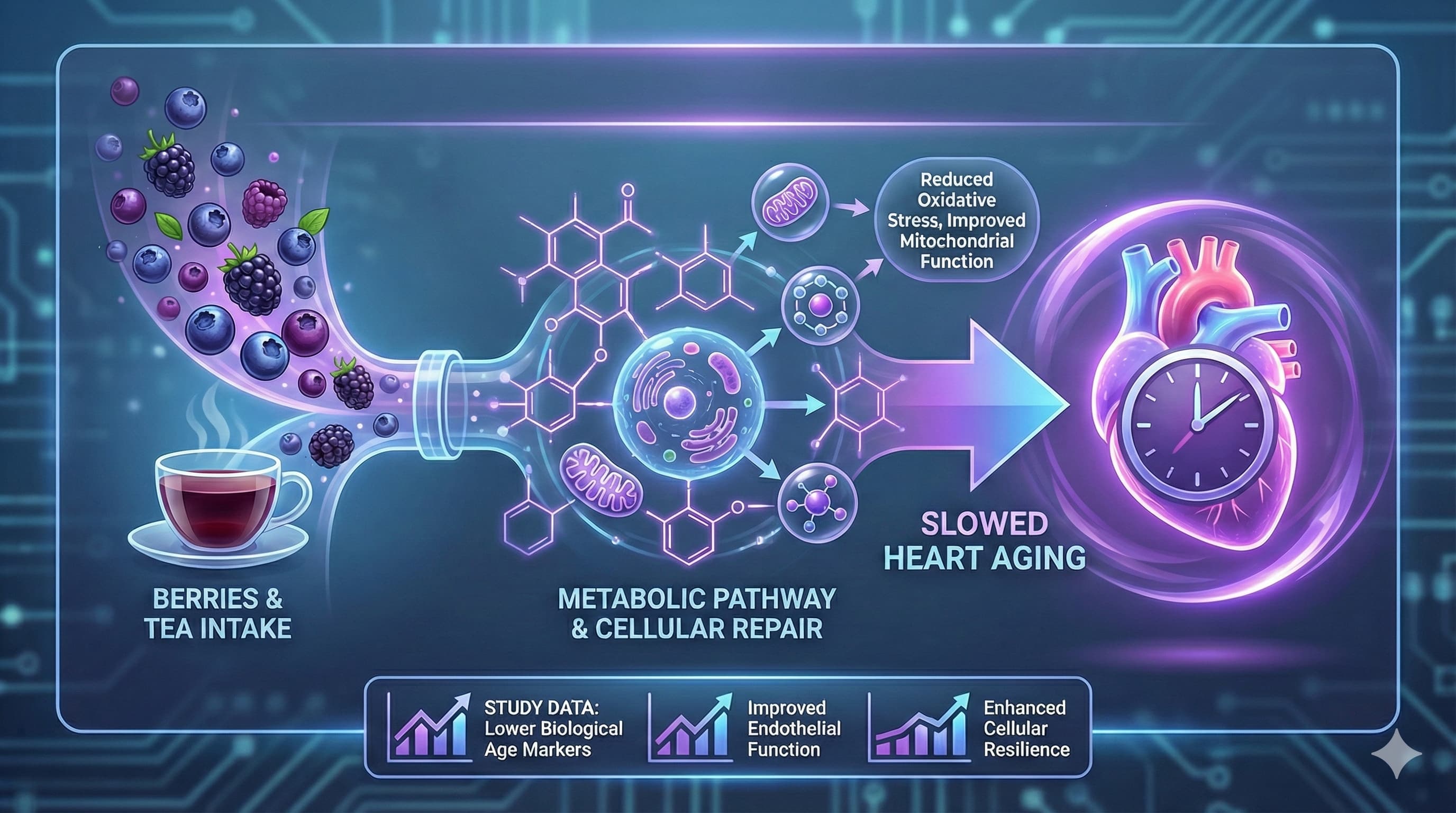
Another Food-related study:
The “Vascular Shield”: High-Dose Cocoa Flavanols Neutralize the Endothelial Damage of Sitting
In a compelling new study from the University of Birmingham, United Kingdom, published in The Journal of Physiology, researchers have identified a potent nutritional “shield” against the vascular devastation of modern sedentary life. The “Big Idea” here challenges the traditional “use it or lose it” dogma of cardiovascular health. We know that prolonged sitting—even in fit individuals—causes blood flow to stagnate, leading to “endothelial hibernation” where arteries lose their ability to dilate. This study reveals that a specific, high-dose intervention of cocoa flavanols (695 mg) consumed prior to sitting can completely preserve endothelial function (Flow-Mediated Dilation), effectively “tricking” the blood vessels into maintaining a high-performance state despite physical inactivity.
Crucially, the study destroys the “fit privilege” myth. The researchers found that being an elite athlete (high VO2 max) offered zero protection against the vascular damage of sitting. Both high-fit and low-fit men suffered the same arterial stiffening when sitting with a placebo. However, the high-flavanol intervention protected both groups equally. This implies that vascular signaling can be pharmacologically decoupled from mechanical shear stress, offering a powerful tool for office workers, travelers, and the injury-prone.
Impact Evaluation:
The impact score of this journal is 4.4, evaluated against a typical high-end range of 0–60+ (e.g., Nature or NEJM), therefore this is a Medium-High impact specialist journal. While not a general science blockbuster, The Journal of Physiology is a prestigious, rigorous venue for mechanistic physiology.
Part 2: The Biohacker Analysis
Study Design Specifications
-
Type: Clinical Trial (Acute, Randomized, Double-Blind, Crossover).
-
Subjects: 40 Young Healthy Males.
-
Group A (High Fit): n=20 (Top tier VO2 max).
-
Group B (Low Fit): n=20.
-
Lifespan Data: N/A (Acute physiological endpoint).
-
Key Intervention: 695 mg Cocoa Flavanols (High Dose) vs. 5.6 mg (Low Dose Placebo) consumed 30-min prior to a 2-hour sitting bout.
Mechanistic Deep Dive
-
Primary Pathway: eNOS / Nitric Oxide Bioavailability. The flavanols (specifically epicatechin metabolites) likely inhibit NADPH oxidase and upregulate endothelial Nitric Oxide Synthase (eNOS). This maintains the “vasodilatory reserve” preventing the endothelium from locking up due to low shear stress.
-
Mitochondrial/Vascular Coupling: The study implies a preservation of Neurovascular Coupling (though measured peripherally). By maintaining FMD, the intervention ensures that nutrient delivery (O2) remains coupled to tissue demand, preventing the hypoxic signaling that often triggers low-grade inflammation during stasis.
-
Aging Priority: Vascular Stiffness & Hypertension. This directly targets the Arteriosclerosis aging vector.
Novelty
We knew flavanols were “good for blood pressure.” We did not know that they could fully negate the acute vascular pathology of sitting. The revelation that baseline fitness provides no protection against sitting-induced dysfunction is a paradigm shift, validating the “Active Couch Potato” theory (you can run a marathon and still rot your arteries at a desk).
Critical Limitations
-
Acute vs. Chronic: The study only measured effects over a 2-hour window. We do not know if this protection holds for 8 hours of sitting or if the effect diminishes with daily habituation (tachyphylaxis).
-
Gender Gap: Only males were studied. Hormonal cycles (estrogen is vasoprotective) might alter this dynamic in females.
-
Source Ambiguity: The “cocoa drink” was highly standardized. Replicating this with grocery-store dark chocolate is metabolically risky due to sugar/calorie load.
Part 3: Actionable Intelligence (Deep Retrieval & Validation)
The Translational Protocol
Biomarker Verification Panel
-
Efficacy Markers:
-
Clinical: Flow-Mediated Dilation (FMD) is the only true verification, but inaccessible to most.
-
Proxy: Systolic Blood Pressure. A drop of 2–4 mmHg post-ingestion indicates vasodilation.
-
Biohacker Proxy: Salivary Nitric Oxide Strips (e.g., Berkeley Life). Use 90 mins post-dose to verify NO upregulation.
-
Safety Monitoring:
- No specific liver/kidney toxicity signals at this dose. Watch for GERD/Acid Reflux due to the acidic nature of cocoa/theobromine.
Feasibility & ROI
-
Sourcing: High feasibility. Standardized extracts (e.g., CocoaVia) or “Lavado” (washed) cocoa powder.
-
Cost vs. Effect:
-
Supplement Cost: ~$1.00–$1.50 per effective dose (695mg).
-
ROI: High. It acts as an “insurance policy” for days when standing desks or walking breaks are impossible.
Population Applicability
-
Contraindications:
-
Hypotension: Potent vasodilators can lower BP too much in those with naturally low pressure.
-
Bleeding Disorders: High-dose flavanols have a mild anti-platelet effect (similar to baby aspirin). Consult MD if on Warfarin/blood thinners.
Part 4: The Strategic FAQ
1. Does taking this blunt the benefits of my morning workout?
Answer: Potentially. Antioxidants can blunt the ROS (Reactive Oxygen Species) signaling required for mitochondrial adaptation if taken immediately post-exercise. Strategy: Separate the dose from your workout by at least 3-4 hours. Use this strictly for the “sedentary block,” not the “training block.”
2. Can I just eat Dark Chocolate (85%)?
Answer: Technically yes, but practically no. To get 695mg of flavanols, you’d likely need to eat ~80g+ of commercial dark chocolate. That is ~500 calories and 20g+ of saturated fat. For a longevity protocol, the “caloric tax” is too high. Use extracts.
3. Does this interact with Rapamycin?
Answer: Likely a positive interaction. Rapamycin inhibits mTOR; cocoa flavanols stimulate PGC-1α (mitochondrial biogenesis) and eNOS. There is no known negative interference. In fact, improving vascular delivery might enhance Rapamycin’s tissue distribution.
4. Does this interact with Metformin?
Answer: Synergistic. Animal models show that combining flavonoid-rich cocoa with metformin preserves pancreatic beta-cell function better than either alone. Both improve insulin sensitivity via distinct pathways (AMPK vs. NO/Insulin signaling).
5. Is the effect cumulative or acute only?
Answer: This study was acute (single dose). However, chronic intake of flavanols is linked to structural vascular improvements (decreased stiffness). You get the acute “vasodilation” benefit immediately, and the chronic “remodeling” benefit over months.
6. Will this break my fast?
Answer: Pure cocoa extract (capsule) will not. A “cocoa drink” (like in the study) often contains carbs/protein. Check the label. The flavanols themselves are non-caloric signaling molecules.
7. How does this compare to just using a Standing Desk?
Answer: Standing represents a mechanical solution; cocoa is a chemical solution. Standing physically increases shear stress. Cocoa chemically mimics it. Best Practice: Do both. Use cocoa as a backup when you must sit (e.g., long flights, deep work).
8. What about Heavy Metals (Cadmium)?
Answer: A major concern. Cacao plants hyper-accumulate cadmium from the soil. Frequent biohackers must verify the heavy metal COA (Certificate of Analysis) of their source. Sourcing from Latin America often carries higher cadmium risks than West Africa, though genetics vary.
9. Does the “High Fit” finding imply cardio is useless for vascular health?
Answer: No. Cardio builds the capacity (max vessel diameter, capillary density). However, cardio does not prevent the acute shutdown of that capacity during sitting. You need cardio to build the engine, and movement (or flavanols) to keep the fuel lines open.
10. Can I mix this with L-Citrulline or Beetroot juice?
Answer: Yes. This creates a “NO Stack.” Beetroot provides dietary nitrates (precursor), while Cocoa Flavanols upregulate the enzyme (eNOS) that processes them. This is a potent combination for maximizing vasodilation.