I live where odds are everything. You are in denial if you think your LDL is okay.

If you have been reading the threads, you should know that the preponderance of the evidence says your LDL is too high. Your HDL is a signal that something is wrong.

Odds are you need to be on a statin. You can bet against the house, your choice.

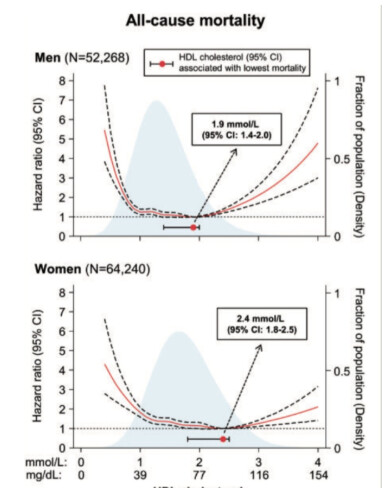
I’ve found multiple large-scale studies showing a ‘U-shaped’ risk curve. This means that both very low and very high HDL levels are linked to an increased risk of mortality, directly

contradicting the old ‘higher is better’ mantra. “The association between HDL cholesterol concentrations and all-cause mortality was U-shaped for both men and women, with both extreme high and low concentrations being associated with high all-cause mortality risk.”
image

"The causal leap that HDL-C was a cause of protection, not just a marker, created a testable therapeutic hypothesis: pharmacologically raising HDL-C levels should reduce cardiovascular events. This hypothesis was pursued for decades, culminating in one of the most expensive and high-profile series of failures in modern pharmaceutical history.

"High-density lipoprotein cholesterol (HDL-c) has long been referred to as ‘good cholesterol’ due to its apparent inverse relationship with future CVD risk. More recent research has questioned a causal role for HDL-c in this relationship, however, as both genetic studies and numerous large-scale randomised controlled trials have found no evidence of a cardiovascular

protective effect when HDL-c levels are raised."

“A critical revelation was that “HDL” is not a single entity. It is a highly heterogeneous (the quality of being diverse in composition) population of particles of different sizes, densities, and compositions.1 These particles can be classified broadly by density (e.g., lipid-rich HDL2 and protein-rich HDL3) 2 or charge (e.g., pre-β-HDL).”

This new paradigm leads to a practical “clinical triage” for interpreting an HDL-C result in 2025:If HDL-C is LOW (e.g., <40-50 mg/dL): Do not treat the HDL-C. Use this as a “risk enhancer”.67 The appropriate response is to be more aggressive in lowering the LDL-C target and to strongly advocate for lifestyle changes.8If HDL-C is NORMAL (e.g., 50-80 mg/dL): Acknowledge it and move on. This number is not the goal. The clinical focus remains 100% on achieving the patient’s LDL-C goal… 63 If HDL-C is “EXTREMELY” HIGH (e.g., >80-90 mg/dL): Do not celebrate. Treat this as an “abnormal level” and a red flag.13 This warrants an investigation into underlying causes, including alcohol use disorder, genetic dysfunction (like $SCARB1$), or other metabolic diseases.

https://academic.oup.com/eurheartj/article-abstract/38/32/2478/3608700?redirectedFrom=fulltext&login=false

3 Likes

I suggest this article: Rethinking Atherosclerosis: A 21st Century Approach - How Low Should LDL Really Go?

2 Likes

I have ben taking 6mg weekly every other month. Don’t notice anything, but hope to increase health span/longevity. Problem just arose when I was going to purchase a short term/long term care policy (I am 63). The insurance company does not want to write the policy because they think I take it for an organ transplant…

1 Like

How does the insurance company know you’re taking rapamycin? None of my healthcare providers know I’m taking rapamycin. Nor any other drug that I take that has not been prescribed by my doctor. I take empagliflozin, telmisartan, bempedoic acid + ezetimibe, pitavastatin in addition to rapamycin. None of this is in any database anywhere, certainly not reported by me to any health provider or insurer. None of my friends know. Only my wife, and this website, where I’m active as CronosTempi.

What is the advantage of a doctor knowing you take it? The vast majority have no idea about rapamycin, or any prescription drug in its off label use of longevity indication. So they’re likely to be utterly useless in assisting you in any way - with rare exceptions of doctors who specialize in the field. Of course, you may not feel you have enough medical knowledge to safely take a drug without a doctors supervision. But if that is the case, then odds are you should not be taking that drug at all. If you are taking any drug without it being prescribed by a doctor, it is on you to do all the research to be confident in your choices, and if you get to that level, you will discover that you now know more about this drug and its likely impact on your health than almost any ordinary doctor out there who doesn’t specialize in this field. These can be powerful drugs, and it’s a big responsibility to take upon yourself.

As to insurance companies, the less they know, the better. There is no way in which you benefit by an insurance company knowing your health status. Also, as a patient, you should have an appropriate relationship with your doctor, by which I mean, it is you who should have the ultimate decision making power when it comes to your health. The doctor is an advisor. In that capacity, you can sometimes ask for medical advice and preface it by asking whether you can ask this question off the record, and not have it recorded in your medical file. If they agree, you ask your question. Speaking for myself, I simply do not share everything with my doc. He’s there as a representative of the healthcare system, including insurance companies, and I go there for my yearly physicals to keep my insurance. That’s it. Example: I am soon having cervical fusion surgery, and insurance is paying for it. This is the first time I have used insurance resources in a big way, after a lifetime of paying premiums. This is the purpose of insurance: big, often unexpected, costly procedures and care. This is why I have it, and why I have always paid my premiums. But they need know nothing else. Now it is on me to handle the drugs I take around this surgery. I’ve done my research. We’ll see. My PCP is involved only insofar as absolutely necessary. Your info is your info, and you should share it as little as possible, I think. YMMV.

5 Likes

Thanks. My HDL used to be in the 80-90 range up to 5 years ago. I then started TRE 16:8 and 2 years ago I added weekly 24h fast. I also increased my exercise level from about 10h/week to 15h/week. Now my HDL is in the 120 range while my Triglycerides came down to 40 range. I read that both Fasting and Exercise seem to drive HDL higher and Triglycerides lower… I’ll discuss all of that with the Cardiologist in Januari.

The Economist also has a new piece on LDL/HDL and Cholesterol complexity:
https://archive.ph/c0Saj

2 Likes