Notícias

RapAdmin

Two new studies on rapamycin shows how short-term treatment with rapamycin very early in life may provide lifespan and healthspan benefits, but it also seems there is a cost in terms of growth (so this dosing strategy seems unlikely to be something that humans will implement).

…we subjected genetically diverse UMHET3 mice to the mTOR inhibitor rapamycin for the first 45 days of life and followed them up until death.

Treated mice grew slower, with most of the deceleration occurring in the first week, and remained smaller for their entire lives. Their reproductive age was delayed but without affecting offspring numbers.

Rapamycin initially reduced DNA methylation age of livers, however, that effect was lost with aging.

Overall, the results demonstrate that short-term rapamycin treatment during early life is a novel longevity intervention that establishes causality between pace of development and longevity in evolutionary distant organisms.

Lifespan can be extended during a specific time window early in life

Here, we found that a short rapamycin treatment during early life can prolong lifespan in Mus musculus and Drosophila melanogaster. Notably, the same treatment at later time points has no evident effect on lifespan, suggesting that we found a crucial time-window involved in lifespan modulation

https://www.biorxiv.org/content/10.1101/2022.02.18.480980v1?ct=

RapAdmin

A drug that extends your life, slows ageing and staves off the ravages of old age, including frailty and disease? It sounds too good to be true, and yet, an increasing weight of evidence suggests not just that these drugs are within reach, but that they may already be here.

And many people who are visiting this website know that anti-aging pills are real and are taking them already precisely because they do know it…

From the new BBC Science Focus Magazine Issue: Why We Don’t Have to Get Old Any More

RapAdmin

A well-written story out of the most recent issue of GEN Biotechnology:

When the drama that has besmirched the field of aging research is set aside, some impressive science underlying the antiaging industry can be unpacked. But in a field shrouded in quasi cures, some sold by leading scientists, a deep dive requires perpetual questioning of scientific integrity.

[Richard] Miller’s ITP [Interventions testing program] has identified at least five compounds that show promise in mice. Rapamycin extended lifespan in males and females (at three different doses, three times in a row), even when started in middle age. Other lifespan extension drugs identified by the ITP include acarbose, which works better in males than in females; 17α-estradiol; and glycine. Nordihydroguaiaretic acid (NDGA), the first compound evaluated by the ITP, is an anti-inflammatory with antioxidant properties, which works only in male mice. The study’s most recent hit is canagliflozin, a drug that blocks the kidney’s ability to reabsorb secreted glucose. Unpublished data suggest that canagliflozin improves some other aspects of late life pathology.

None of the effects seen with these drug candidates could be achieved by diet alteration, says Miller. “People have a fantasy that if you just stop eating, and become calorically restricted, you’ll live a long time. It’s the same fantasy that if you could just flap your arms fast enough, you could fly,” he says. Humans have inbuilt mechanisms that prevent them from starving to death, says Miller, nor do they have the discipline necessary to lose 40% of their body weight, and keep it off. This is not a practical clinical solution, he says.

Read the full article at the link below:

https://www.liebertpub.com/doi/10.1089/genbio.2022.29013.jlm

RapAdmin

Another new story on Altos Labs, and related developments:

and a related podcast, where they interview some of the UK’s leading geroscientists and provide more background on the above news story:

And the backlash from some people in the scientific community (Dr. Levine has joined Altos) against the “We’re going to live forever” talk (of which there is little scientific evidence) by some people:

RapAdmin

This is big news… another major startup company working to develop rapamycin-like drugs, this time with Joan Mannick as the CEO of the company. This is yet another vote of confidence on rapamycin, and the MTOR pathway as being a key target for life extension.

Joan Mannick has said this regarding mTOR as a target for aging.

“I don’t think there’s a target that’s better validated for regulating longevity,” she says. “Even more specifically, there is no therapeutic that’s better validated than rapamycin for targeting aging and extending lifespan.”

While we are excited about the potential for these new mTOR inhibitors it remains to be seen if any of these new rapamycin-like drugs (rapalogs) are better than rapamycin itself. And if these new rapalogs do work well, what is the cost, and is their high price justified when you look at a cost/benefit analysis compared to rapamycin. On-patent mTOR inhibitors have typically been priced high (e.g. $500 per 10mg/tablet; see Good RX Afinitor 10mg/30 tablets here). This compares to an approx. street price of $10 to $50 for 10mg of sirolimus / rapamycin. So the ultimate question will be, is the new mTOR inhibitor so much better than rapamycin that it justifies its 10X to 50X higher price? Is the marginal benefit greater than the marginal cost? We’ll see…

James Peyer, CEO of Cambrian BioPharma said on twitter today (see this thread) that the benefit they think that Tornado Therapeutics may bring to the table is a wider therapeutic window (i.e. broader dosing range without side effects). This is an important consideration, especially for people pushing the envelope on dosing, or who don’t respond well to rapamycin for whatever reason. It will be interesting too see how this develops over the coming years. I hope that Tornado Therapeutics does some head-to-head comparisons with rapamycin so we can see the differences clearly.

Joan Mannick was the lead scientist out of Novartis who did the ground-breaking 2014 study which was the first to show that a rapalog (Everolimus) could be used safety in older humans with beneficial anti-aging effects (on the immune system). This study was was the first to suggest that the anti-aging effects of rapamycin that has proven so effective in yeast, worms, and mice, seems likely to translate to humans also. This study is what really led directly to rapamycin being taken up by early adopters like Drs. Alan Green, Blagosklonny, and Attia and expanding to many other health and longevity enthusiasts since then.

Joan Mannick went on to spin an MTOR inhibiting compound (RTB101) out of Novartis into a new company (ResTORbio) to pursue it as an aging therapeutic. That compound did well in initial clinical studies but then in the Phase 3 study the FDA “moved the goalposts” and decided to only accept patient-estimates of improvement in this second clinical trial (which it failed in), not clinical measures done by doctors (which it succeeded in).

When talking later about the trial, Joan said:

Mannick explains that the FDA decided the Phase 3 endpoint should be based on respiratory infection symptoms and not laboratory-confirmation of an infection. This was because laboratory-confirmation of an infection was not relevant to how patients feel and function.

“The Phase 3 trial missed the primary endpoint in part because it turned out to be difficult to distinguish respiratory symptoms that were due to an infection from non-infectious respiratory symptoms,” she says. “However we learned a lot from that trial that will help inform the design of future trials.

Additional Video Interviews of Joan Mannick here, and here.

Here is the new announcement on the new company:

Feb. 16, 2022 /PRNewswire/ – Cambrian Biopharma, a multi-asset longevity biotech, today announced a licensing agreement with Novartis to advance novel, selective compounds designed and characterized by Novartis to target the mechanistic target of rapamycin (mTOR) pathway. The licensed assets are structural analogs of the FDA-approved drug rapamycin, which has been shown to prevent or reverse multiple age-related health deficits in mice and extend their average lifespan by up to 31%.

Read the full story: Click Here

RapAdmin

The mTOR inhibitor market continues to evolve and move forward, this time with a new deal where the mTOR-focused startup company Navitor Pharmaceuticals (of which David Sabatini is a co-founder) is selling one of its compounds to J&J who will continue to test and potentially commercialize it.

From our perspective, the more mTOR inhibitors on the market the better, so we are happy to see this development and ongoing investment and clinical testing of mTOR inhibitors. We hope that Richard Miller and his team at the NIA ITP program can test this compound in its lifespan studies.

These new mTOR1 inhibitors are, I believe, different from the rapalogs (rapamycin, everolimus, temsirolimus) in that they are highly targeted only at mTORC1, and less inhibitory of mTORC2, which is thought by many researchers to be the source of many of the side effects that people experience at higher doses. It will be interesting to see how this plays out in terms of the side effect profiles and life extension effects of these new drugs.

Today, privately held Navitor Pharmaceuticals, LLC, announced that Janssen Pharmaceuticals, Inc. has acquired Anakuria Therapeutics, Inc., a company recently formed by Navitor to advance its novel class of selective rapamycin analog mTORC1 inhibitors. Anakuria’s lead Phase 1 ready program, AT-20494 provides Janssen with a first-in-class opportunity in autosomal dominant polycystic kidney disease, or ADPKD. This deal was facilitated by Johnson & Johnson Innovation.

Tom Hughes, president and chief executive officer of Navitor Pharmaceuticals LLC commented, “We are thrilled that the potential value and substantially differentiated profile of Anakuria’s mTORC1 inhibitor program can be explored with Janssen. With decades of experience in developing, manufacturing and commercializing innovative therapies for patients suffering from a broad range of diseases and conditions, Janssen is ideally positioned to rapidly advance our program in the clinic. We also are very pleased that the program has come full circle within the Johnson & Johnson Family of Companies: Johnson & Johnson Innovation – JJDC, Inc., the strategic venture arm of Johnson & Johnson, was one of Navitor’s founding investors and the company also was one of the initial startups incubated in JLABS @ LabCentral, Cambridge, MA.”

About AT-20494

AT-20494 is an orally bioavailable small molecule that selectively inhibits activity of mTORC1, the master modulator of cellular metabolism, which is overactive in multiple chronic diseases including autosomal dominant polycystic kidney diseases. AT-20494 is a member of a novel class of rapamycin analogs discovered by Navitor scientists, and will be the first fully selective inhibitor of mTORC1 to be studied in humans. Preclinical studies of AT-20494 have shown that it reduces the burden of cysts and kidney volume in mice carrying mutations in the PKD1 gene, and also reduces signatures of fibrosis and inflammation upon chronic administration.

About mTORC1

Complex 1 of the mechanistic target of rapamycin (mTORC1) activity governs the pace and ability of the cell to synthesize protein and other cellular components. Increased mTORC1 activity contributes to a broad array of diseases of aging by increasing protein misfolding and driving cellular stress, inflammation, and fibrosis.

About Navitor

Navitor Pharmaceuticals, LLC, the parent company for Navitor Pharmaceuticals, Inc., is the leader in the development of mTORC1-targeted therapeutics designed to help patients live longer and healthier lives. The Company’s proprietary platform enables highly specific modulation of mTORC1, the gatekeeper of cellular metabolism and renewal, and has produced two clinical candidates. NV-5138, Navitor’s small molecule that directly activates mTORC1, is in Phase 2 development for treatment-resistant depression, with additional opportunities in cognition and memory, in partnership with Supernus Pharmaceuticals, Inc.

More details and write up below by EndPoints News which covers the biotech and pharma industries.

Unfortunately its obvious that the person writing the story below doesn’t know much about mTOR inhibitors, their history and success in lifespan extension.

https://endpts.com/with-new-buyout-jj-jumps-back-in-on-a-storied-but-troubled-holy-grail-target/

Related Research:

Prospects for mTOR Inhibitor Use in Patients with Polycystic Kidney Disease and Hamartomatous Diseases

RapAdmin

DavidSinclairRapa

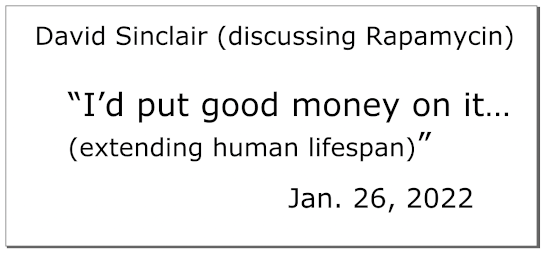
From David Sinclair’s most recent podcast here (Que’d up for the rapamycin discussion): NMN, NR, Resveratrol, Metformin & Other Longevity Molecules | Lifespan with Dr. David Sinclair #4

Of course, they are wrong on rapamycin being hard to get, “not available for purchase or prescription” etc… as we have a list here of doctors that prescribe rapamycin, and places where you can buy rapamycin easily and inexpensively.

Related Post: David Sinclair is now using Rapamycin?

EnrQay

This is a promising targeted rapamycin therapy when combined with pancreatic islet transplant:

Using these rapamycin-loaded nanocarriers, the researchers generated a new form of immunosuppression capable of targeting specific cells related to the transplant without suppressing wider immune responses.

RapAdmin

Good news on the cellular rejuvenation projects being researched by Altos Labs.

Klausner’s new biotech is reminiscently named Altos Labs, partially exposed last fall by a scoop from MIT Technology Review’s Antonio Regalado, who put billionaire Jeff Bezos in the funding room with Milner on a story headlined as “Silicon Valley’s latest wild bet on living forever” that pictured Bezos’ head on the weary knight Max von Sydow plays on the classic Bergman film The Seventh Seal as he plays chess with death.

To hear Klausner tell it, though, that kind of loony, billionaire escape route to immortality is not what he has in mind at all.

Altos Labs Press release:

News Coverage of Altos Labs’ launch

The Economist Magazine Full article: A $3bn bet on finding the fountain of youth

https://invesbrain.com/what-kind-of-biotech-startup-wins-a-3b-syndicate-woos-a-gallery-of-marquee-scientists-and-recruits-gsks-hal-barron-as-ceo-in-a-stunner-let-rick-klausner-explain/

Altos Labs Website:

Elizabeth_Kirby

The Dog aging project has received some new funding.

the Dog Aging Project is conducting a double-blind, placebo controlled, veterinary clinical trial of the medicine rapamycin, which at low doses has been shown to extend lifespan in laboratory animals. The trial is called TRIAD, an acronym for Test of Rapamycin in Aging Dogs.

The $2.5 million in new funding provided by the consortium of donors will go directly to scientific research. This support will allow the Dog Aging Project to expand the TRIAD Trial to include more study locations and to increase the number of dogs enrolled in TRIAD.

Details on how the funding will be used to expand the dog aging project here:
Matt Kaeberlein Rapamycin Dog Study.pdf (644.6 KB)