Notícias

RapAdmin

HPPollWide

There seems to be a lot of potential for higher doses of rapamycin to provide greater benefits in terms of longevity and health.

In the research studies on rapamycin, the higher the dose given, the longer the lifespan of the animals (at least in males). In female mice the seemed to have reached a peak longevity benefit at around 28% increased lifespan using a dose of 2mg/kg.

But, we still don’t have a good idea of how these mice dosing protocols translate to humans, nor do we know exactly how higher doses on a periodic dosing protocol may be associated with any adverse events or side effects in healthy people. Right now the typical dosing for rapamycin in anti-aging applications is 5mg to 10mg (once per week). The goal would be to test higher doses; from 10mg to 40mg on either a weekly or every two week dosing period.

Please indicate your interest: Click Here to Complete Poll

RapAdmin

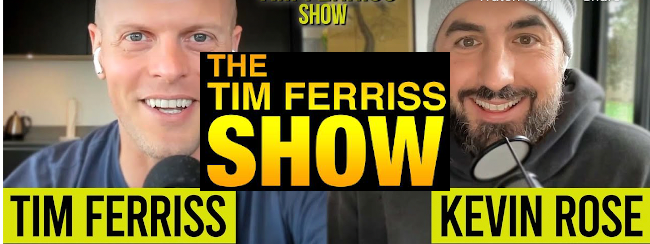
On Tim Ferriss’ podcast: Kevin has a positive experience with rapamycin, and sees his old dog rejuvenated and now full of energy.

There is lots of joking around here between Tim and Kevin, but generally a very positive review by Kevin on rapamycin (a short 8-week stint) - that helped his knee pain (rapamycin seems to be great for lowering inflammation) and on the rejuvenation of his dog.

Key take-home points here:

So I just wanted to see what it would do if I noticed anything different. I had some knee joint pain in my right knee that hadn’t gone away for a few months… that went away.

On Kevin’s dog’s experience taking rapamycin:

Tim, there is an absolute difference. Darya and I will tell you that — he’s having some hip issues as he’s getting older, his hips slip out from underneath him from time to time. And it doesn’t help that we have concrete floors and it makes that a little more slippery for him.

But now he’s jumping up on people now when they come in the house, including us, and just the level of excitement and energy and everything else that’s come out of him.

He’s been on it for about two months now. It is working.

Read the full story and see the podcast video here: Tim Ferriss / Kevin Rose Rapamycin

RapAdmin

RapamycinRapamune650

Rapamycin is by far the world’s leading candidate for an effective and accessible anti-aging drug. Nothing else comes close. If you’re interested in a longer, healthier life, you probably want to consider taking rapamycin or at least keep a close eye on the research going forward.

Rapamycin is considered by many geroscience researchers to be the “gold standard” of anti-aging drugs for some very good reasons:

  • Its been shown to be very effective in every species its been tested in, from yeast, to worms, to flies, to mice. Rapamycin is now in ongoing, longterm testing in healthy monkeys and dogs with success reported to date.

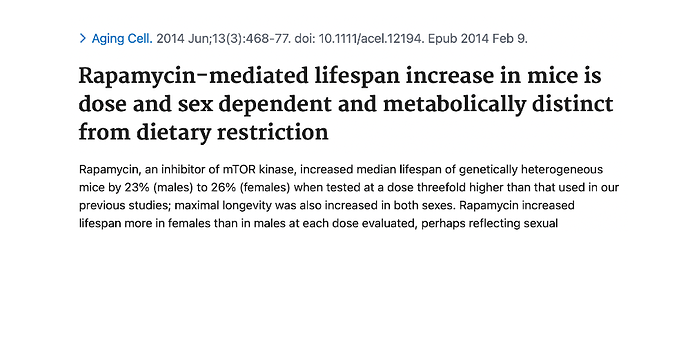
  • The lifespan improvement seen in animal trials are the most consistent and highest of any drug (typically 9% to 30% in mouse studies). Dozens of independent studies report lifespan and age-related health benefits from rapamycin in mice, including reversal of deficits in multiple tissues. At least two studies show big effects from transient treatments during middle-age.

  • In addition to lifespan, the things rapamycin improves in aging mice are: cancers (better outcomes), cognitive function, heart, immune, kidney, oral health, intestine/gut dysbiosis, tendon, liver, auditory function, ovary, stem cells, spinal discs…

  • Rapamycin’s efficacy has been validated by many different independent research groups around the world.

  • Rapamycin is FDA approved (albeit at high doses for cancer and transplant patients), and has been used in millions of patients over the past 20 years.

  • Because rapamycin is off-patent, and now available as a generic medicine it can be very affordable, or even inexpensive.

  • Doctors have started to prescribe rapamycin for anti-aging, and thousands of people are already using it.

The key issue with rapamycin is that there currently is no clear pathway to approval by the FDA for an anti-aging drug, and no commercial entity wants to fund large human clinical studies for rapamycin because its already a cheap generic drug and companies can’t make money off it. Small human clinical studies are in process, but these small clinical trials will take years, and even then likely won’t satisfy the FDA (a typical phase 3 clinical trial has 3,000 patients enrolled, the rapamycin human clinical studies planned today only have 20 to 150 people). Additionally, the FDA has little history in area of drugs for prevention (though statins may be a counter-example to that). So rapamycin may continue to be overlooked by the medical establishment for many decades going forward.

Thousands of people around the world have already decided that the evidence is compelling enough and they don’t want to wait years (or decades) for a large-scale, human clinical trial to finally be funded and completed. These people have shared the research data we cover on this website with their doctor (or found a doctor - see our list), and gotten a prescription for rapamycin, and are following a low-dose, intermittent/pulsed dosing protocol with some success.

Read the full story about rapamycin and make your own decision.

The full story: Why take Rapamycin? (part 2)

RapAdmin

RapaClinicalTrial1

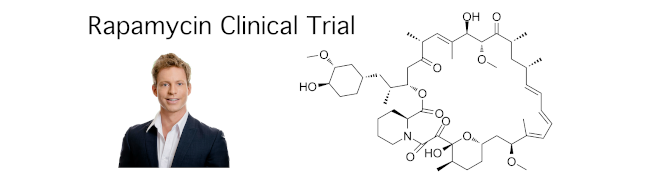
Dr. Bradley Stanfield, a young doctor (GP) out of New Zealand who hosts is own YouTube channel focused on health and longevity, has announced plans for a new clinical trial for rapamycin focused on stopping muscle decline in older adults.

It appears that he’s partnered with Lifespan.io as far as fund raising, a new effort which they have just launched and which is being advertised on YouTube (Dr. Brad Stanfield’s Channel, Sheeky Science Show / Lifespan.io Channel).

Overview of clinical trial planned:

A 13-week, randomised, double-blind, placebo-controlled, Phase 2a Proof of concept trial of 30 participants, with 20 in the placebo arm and 10 in the Sirolimus (Rapamycin) arm. The patients shall complete a thrice-weekly group exercise program. The medications shall be taken once a week, and during the trial the exercise program shall be standardised.

Dosing: Sirolimus (Rapamycin) 5mg weekly dosing, or a placebo

Read the full story here: New Rapamycin Clinical Trial: Muscle Focus (Part 2)

RapAdmin

The new study out of MIT suggests that cellular enlargement drives a decline in function of stem cells. The researchers found that blood stem cells, which are among the smallest cells in the body, lose their ability to perform their normal function — replenishing the body’s blood cells — as they grow larger. However, when the mice were treated with rapamycin the blood stem cells were maintained at their usual size and, they behaved normally.

When the researchers treated mice with rapamycin, beginning at a young age, they were able to prevent blood stem cells from enlarging as the mice got older. Blood stem cells from those mice remained small and were able to build blood cells like young stem cells even in mice 3 years of age — an old age for a mouse.

From the study:

Last, we show that murine and human hematopoietic stem cells enlarge during aging. Preventing this age-dependent enlargement improves HSC function. We conclude that small cell size is important for stem cell function in vivo and propose that stem cell enlargement contributes to their functional decline during aging.

Adult stem cells are critical for the maintenance of many tissues in our body. For example, hematopoietic stem cells (HSCs) build the blood system throughout life. Their magnificent ability to proliferate and differentiate into the blood lineages is illustrated by the observation that a single HSC can repopulate the hematopoietic compartment of a lethally irradiated mouse when coinjected with radioprotective bone marrow (BM)

In summary, we have examined six different experimentally induced or physiological conditions, under which hematopoietic stem cell exhaustion occurs: irradiation-induced DNA damage, Cdk4/6 inhibition, hyperactivation of mTOR, high division rate during transplantation, repeated pregnancy, and naturally large hematopoietic stem cells. We observe that hematopoietic stem cells enlarge under all these conditions. In all experimental settings, in which this could be investigated, preventing HSC enlargement with rapamycin preserved HSC fitness.

Our findings may have implications for rejuvenation therapies to improve stem cell function during aging. Rapamycin treatment has been reported to lengthen the life span of mice and improves the function of aged HSCs (67, 68). Our data indicate that rapamycin prevents the enlargement of HSCs and thereby protects them and potentially other stem cells from aging. However, rapamycin does not restore HSC function once they are large.

Rapamycin, a drug that can inhibit cell growth, is now used to treat some cancers and to prevent organ transplant rejection, and has raised interest for its ability to extend lifespan in mice and other organisms. It may be useful in slowing down the enlargement of stem cells and therefore could have beneficial effects in humans, Lengefeld says.

Read the Full story on the MIT website: For stem cells, bigger doesn’t mean better

Full Research paper here.
RapAdmin

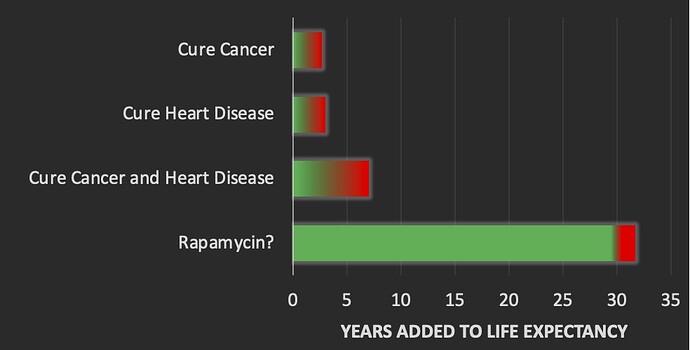
Here is Matt Kaeberlein’s latest estimate on the years of added life that rapamycin may be able to provide to people after optimized human dosing protocols are researched and defined.

From Matt Kaeberlein’s recent tweet.

Below is a link to the research paper covering the results in his lab’s last mouse study, where a 3 month high dose of rapamycin at late middle age resulted in a 61% increase in remaining life expectancy (so, if done on a 50 year old human who today has a 30 year remaining life expectancy (i.e. 80 yrs total), you would expect to get 18 or so years.

This is based on the dosing / interval studies that have been done on mice so far. With a more rigorous effort related to dosing / interval optimization clinical studies in humans it may not be unreasonable to see upwards of 30 years life expectancy improvement with rapamycin (see tweet here explaining this).

Update: On Nov. 24th Matt Kaeberlein posted a more in-depth series of tweets explaining why 30 years life extension with rapamycin might be possible - see tweet series starting here.

RapAdmin

In this recent study they sought to determine if combining drugs previously shown to improve lifespan would have greater impact than any individual drug, a diet containing rapamycin at 14 ppm, acarbose at 1000 ppm, and phenylbutyrate at 1000 ppm was fed to 20-month-old C57BL/6 and HET3 4-way cross mice of both sexes for three months.

Mice fed the cocktail diet showed a strain and gender-dependent phenotype consistent with healthy aging including decreased body fat and blood glucose, improved cognition, and increased grip strength and walking ability compared to mice fed individual drug or control diets.

A cocktail diet containing one-half dosing of each compound was overall less effective than the full dose. The composite age-related lesion score of heart, lungs, liver and kidney was decreased in mice fed the cocktail diet compared to mice fed individual drug or control diets suggesting an interactive advantage of the three drugs.

Senescence and inflammatory cytokine levels in kidneys from mice fed the cocktail diet were lower than in kidneys from mice fed control diet, and consistent with low expression levels in kidneys from young untreated mice, suggesting the cocktail diet delayed aging partly by senolytic and anti-inflammatory effects.

More information on phenylbutyrate, also known as sodium phenylbutyrate:

Generic name: sodium phenylbutyrate (SOE dee um FEN il BUE ti rate)
Brand names: Buphenyl, SPB11

Sodium phenylbutyrate is an FDA approved orphan drug, marketed by Ucyclyd Pharma under the trade name Buphenyl, by Swedish Orphan International (Sweden) as Ammonaps, aby Fyrlklövern Scandinavia as triButyrate and by Scandinavian Formulas, Inc. (Sellersville, PA)

Read the full story here: Cocktail of Rapamycin, Acarbose and Phenylbutyrate (Part 2)

RapAdmin

ImportedWide3

As we’ve mentioned elsewhere on this site, because prescription medications like rapamycin (when used for anti-aging) are not covered by insurance, people are increasingly looking outside their home country to purchase the medications to save money. The US, for example, has the highest drug prices in the world due to the combined effects of lack of competition and limited regulation (due to lobbyists).

Here is the process that people are communicating to us has worked well for them to obtain the lower cost prescription medications, specifically in this case we are talking about how people purchase their rapamycin (sirolimus).

Step 1. Determine the brand of rapamycin / sirolimus you want to purchase. Read this about the different brands and names of rapamycin.

Step 2. Search on reliable web marts to find the vendors of rapamycin. People are recommending Indiamart.com and Alibaba.com as good starting points.

Read More Here: Importing Rapamycin (part 2)

RapAdmin

Here is a list of the papers we like most. To really understand how rapamycin functions in mammals, and its potential benefits and risks it helps to actually read the full research papers that have been published, and that are (ideally) from double blind, placebo controlled studies.

Here is a list of the rapamycin papers we like:

Read the full story: Top Research Papers on Rapamycin (part 2)

RapAdmin

rapaname11

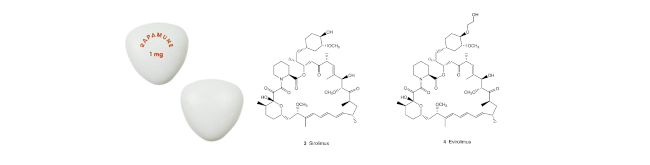
Rapamycin was the original name given to this bio-chemical compound produced by the bacterium Streptomyces hygroscopicus. It was first discovered in a soil sample from Easter Island in 1964 by a Canadian scientific expedition. It was isolated for the first time in 1972 by Surendra Nath Sehgal and colleagues in Montreal from the samples of Streptomyces hygroscopicus.

The compound was originally named rapamycin after the native name of the island, Rapa Nui (and thus the design of our logo at the top of this page). But now there are many different brand and generic names that people use to refer to rapamycin and related compounds. If you’re thinking of taking rapamycin, you should learn all the names of this important medicine.

Read the full story here: Rapamycin Naming Conventions (part 2)